Washers
Washer Not Filling With Water? What to Check First
Washer won't fill, or fills slowly? The checks to try first, from closed valves to clogged inlet screens, what the fill codes mean, and what repair costs.
By Atlanta Appliance Techs · Published · Updated · 9 min read
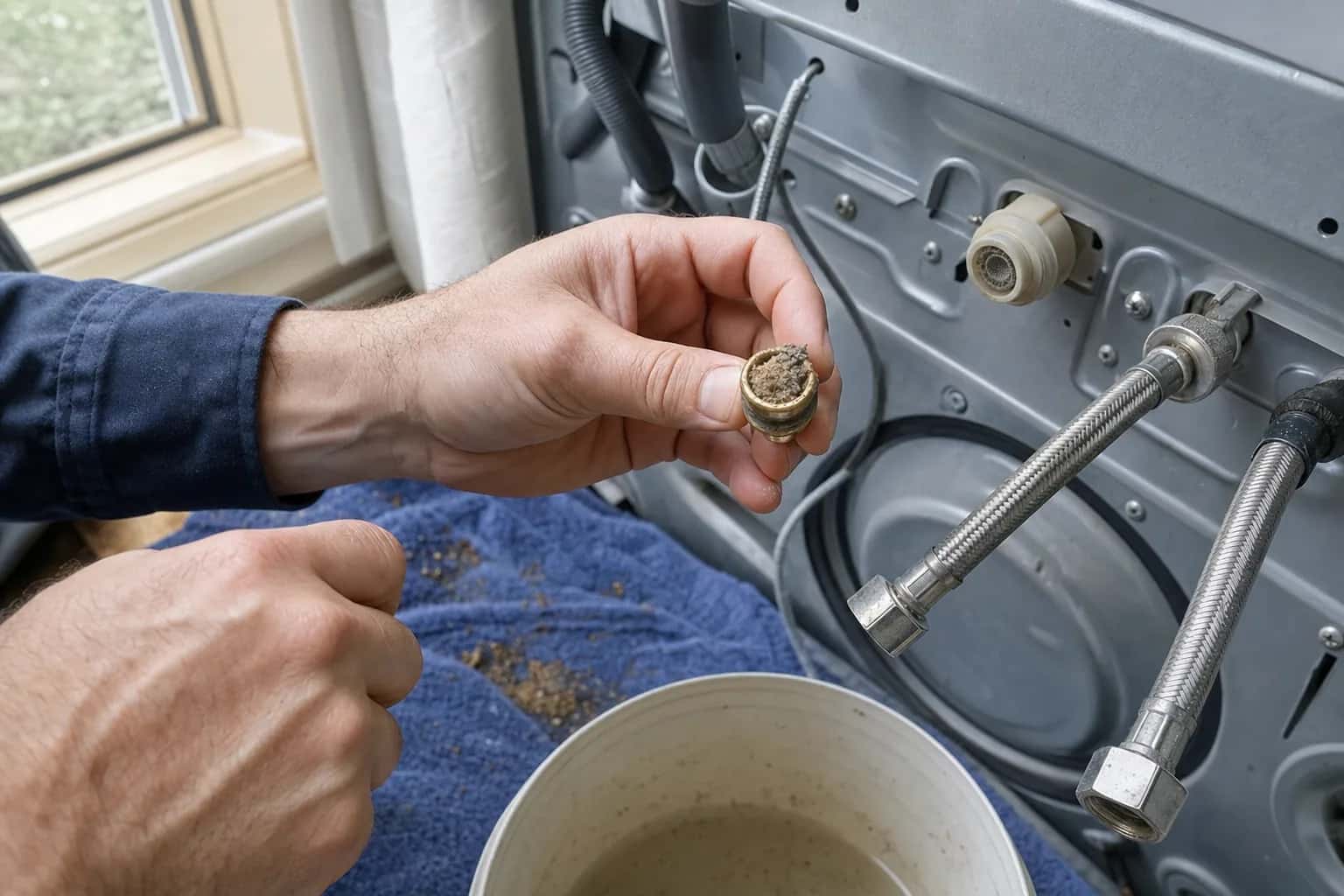
A washer not filling with water, sitting silent when it should be filling or trickling water in so slowly that the cycle stalls, is usually not getting enough water to its inlet valve, or the valve is not opening. Start with the supply side. Closed valves, kinked hoses and clogged inlet screens are the usual culprits, and you can check all three yourself.
Water and electricity do not mix. Turn off both water valves and unplug the washer before you disconnect a hose or reach behind the machine, and keep towels and a bucket handy, because the hoses hold water.
Quick answer
| Symptom | Likely cause | Safe to check yourself? | Typical fix |
|---|---|---|---|
| No water at all, but you hear a hum | Closed valve, kinked hose or clogged inlet screen | Yes: open both valves, straighten the hoses, clean the screens | Free if it is the supply; otherwise a new water inlet valve |
| No water, no hum, display shows the cycle running | Lid or door not locking, or no signal reaching the valve | Partly: close the lid firmly and clean the lid lock area | Lid lock, door lock or control repair |
| Fills very slowly | Partly clogged screens, low house pressure or an anti-flood device | Yes: clean the screens, test another faucet, remove the device | Usually free; an inlet valve if one side stays slow |
| Only hot or only cold arrives | That side's valve closed, its screen clogged, or half of the inlet valve failed | Yes: check that side's valve and screen | Inlet valve if the screen is clean |
| Water runs out as fast as it comes in | Drain hose too deep in the standpipe or taped in, so it siphons | Yes: reset the drain hose | Free fix |
| Stops short, or never reaches the right level | Water level sensor (pressure switch) or its air tube | No | Sensor, switch or tube replacement |
| Fill code (F8 E1, LF, IE, 4C) | Supply problem first, inlet valve second | Yes: the checks below | Inlet valve if the code keeps returning |
First, is it really not filling?
If you have a high-efficiency (HE) washer, especially a top-loader without an agitator, a low water level is normal. These machines sense the load and add only enough water to wet it, so you will not see the tub fill the way an older washer did. Whirlpool says it is normal for some of the load to sit above the water line, and that the load settling as it washes does not mean you should add more items.
Cycle choice matters too. Heavy-duty and bulky cycles fill with more water than the more efficient normal cycles, so a comforter belongs on a bulky cycle, not a normal one. If your washer washes and rinses normally and the clothes come out clean, it is working as designed.
The real problems are no water at all, a fill that stops short, and a fill so slow that the washer stalls or shows an error.
Checks you can do yourself
- Open both valves all the way. The hot and cold valves behind the washer are easy to bump or leave half-closed after plumbing work or a vacation. Whirlpool says both valves must be fully open, and both the hot and cold hoses connected, for its washers to work correctly.
- Check the house water. Turn on the laundry sink or a nearby faucet. If the pressure is weak there too, the problem is in the plumbing or the well, not the washer.
- Straighten the hoses. Pushing the washer back against the wall, or its own vibration, can kink an inlet hose. Pull the washer out a few inches and make sure both hoses curve smoothly. Make sure the red hose goes to the hot valve and the blue hose to the cold.
- Remove anti-flood devices. Whirlpool says an anti-flood device fitted between the faucet and the hose can reduce the water pressure and the amount of water reaching the washer. If you have one, try the washer without it.
- Clean the inlet screens. With the water off and the washer unplugged, unscrew the hoses from the back of the washer (pliers help) and look into the ports. Small mesh screens there catch mineral buildup and debris. Whirlpool says to clean its screens in place, without removing them, using an old toothbrush, mild soap and water.
- On an LG, LG's IE guide says to clear rust, sand or sediment from the inlet filter with your fingers or pliers. Reconnect the hoses and watch for drips when the water goes back on.
- Close the lid or door firmly. Whirlpool says some newer top-loaders will not fill or wash with the lid open, and that clothing, lint and detergent buildup can keep the lid from locking. On a front-loader, make sure nothing is caught in the door seal.
- Reset the washer. Unplug it for five minutes, plug it back in and start a new cycle. Our guide on how to reset a washing machine links each brand's steps.
A quick decision flow
Work down this list and stop at the first yes.
- Is the pressure weak at other faucets too? Then the problem is the house supply or the well. Call a plumber, not an appliance technician.
- Was the washer just moved, or the plumbing just worked on? Check that both valves are fully open and neither hose is kinked or swapped.
- Do you hear a hum or buzz from the back, but no water arrives? Clean the inlet screens. If they are clean and it still hums, the water inlet valve has probably failed.
- Is the lid lock light flashing, or is there a door code? The washer is waiting for a lock it never gets. Clean the lid lock area and close the lid firmly; if that fails, the lid lock or door lock is the likely repair.
- Does water drain away while the washer is filling? The drain hose is siphoning. Fix the hose depth (see below).
- Is there a fill code on the display? Use the code table below for your brand.
- None of the above? The water level sensor, its air tube or the control board is the likely cause, and that needs testing.
Washing machine won't fill at all
Listen when you start a cycle, because the sound tells you where to look.
- A hum or buzz, but no water: the inlet valve is getting power, but water is not coming through. Recheck the valves, hoses and screens. If they are all clear, the valve itself has probably failed.
- Silence, but the display shows the cycle running: the washer may be waiting for a lid-locked or door-locked signal it never gets, or the control may not be sending power to the valve.
- No lights at all: that is a power problem, not a fill problem. Check the outlet, the breaker and any GFCI outlet; our guide to a washer that won't turn on walks through it.
Washer not filling up with water all the way
If the washer adds some water and then stops short, or seems to fill forever without reaching the level it needs:
- On an HE washer, first make sure the level is actually wrong (see above).
- The pressure switch, or water level sensor, may be misreading the level. It works through a small air tube, and a kinked or clogged tube gives false readings. LG's error code list says a PE code means the water level sensor is not working properly.
- Water may be draining as fast as it comes in. Whirlpool's LF guide says only 4.5 inches of drain hose should go into the standpipe and the drain opening should not be taped over; otherwise the washer can siphon, filling and draining at the same time, and never reach the expected level.
Washer fills slowly
A slow fill usually means a restriction somewhere between the house and the valve:
- Partly clogged inlet screens.
- Low household water pressure. Washers need a minimum pressure to fill on time; LG's error code list gives 14.5 to 116 psi for its top-loaders.
- On a well, a clogged whole-house sediment filter, which drops the pressure at every faucet in the house.
- A hose kinked partway, or an anti-flood device.
- A worn inlet valve that no longer opens fully. If only the hot or only the cold side is slow, and that side's screen is clean, the valve is the likely culprit.
Fill error codes by brand
Most washers flag a fill problem on the display once the fill takes too long. Codes vary by model, so confirm yours in the owner's manual.
| Brand | Code | What the manufacturer says it means | Checks to try first |
|---|---|---|---|
| Whirlpool and Maytag | F8 E1, LF, Lo FL | The washer is not detecting the correct amount of incoming water, or is taking too long to fill | Both valves fully open, hoses straight, red to hot and blue to cold, clean screens, no anti-flood device, drain hose depth |
| LG | IE | The water failed to fill the tub to an adequate level in the set time | Faucets fully open, hoses unkinked, inlet filter clean, thaw a frozen supply hose |
| LG | PE | The water level sensor is not working properly | Unplug for 10 seconds and restart; call for service if it returns |
| Samsung | 4C, 4E, nF | Water is not entering the washer correctly | Hot to hot and cold to cold, valves fully open, drain hose 6 to 8 inches into the pipe, a 1-minute power cycle, clean inlet filters |
After an F8 E1, Whirlpool says the door may lock and the washer may run a drain routine of about 8 to 10 minutes, during which the controls will not respond. Let it finish before you start troubleshooting.
If the code comes back after you have checked the valves, hoses and screens, the inlet valve is the usual cause. Owners of LG, Samsung and Whirlpool washers can find the full code lists in our guides to LG washer error codes, Samsung washer error codes and Whirlpool washer error codes.
What usually fails
- Water inlet valve. The usual repair once the supply checks out. The signs are a hum with no water, one temperature missing, or a slow fill even with clean screens.
- Lid switch or door lock. The washer never confirms the lid is closed or the door is locked, so it never starts the fill. A flashing lid-lock light or a door error code points here. Please do not tape or bypass the switch; it is what keeps hands out of a spinning drum.
- Pressure switch or water level sensor. Wrong readings stop the fill too early or keep it from starting. Sometimes the fault is just the air tube.
- Control board. If the valve, switches and sensor all test good, the board may not be sending power to the valve. We confirm this with tests before replacing a board.
If the screens are clean and the valve still hums without passing water, you can book a technician to test and replace the inlet valve.
What washer repair costs in Atlanta
The diagnostic is $80 and is waived when you approve the repair. Washer repairs start at $180 labor plus parts, and a typical washer repair on a standard brand runs $250 to $450 all in; inlet valves, lid switches and door locks fall in that range. You get a written flat-rate estimate before any work begins. The repair can be finished on the first visit when the part is in stock, and if a part has to be ordered, there is no trip charge for the return visit. Every repair carries our 60-day parts-and-labor warranty. See typical total costs on our pricing page.
Keep it from happening again
- Replace rubber fill hoses every five years, as Whirlpool recommends.
- Clean the inlet screens whenever the fill starts to slow down.
- Leave a few inches between the washer and the wall so the hoses never kink.
If your washer fills fine but will not drain or spin, see washer not draining or spinning.
Schedule a visit or read about our washer repair service. Prefer to talk? Call (470) 778-4087.
Sources
- Whirlpool: F8 E1 or LF or LO FL error code in display
- Whirlpool: Water usage in a top load HE washer
- Whirlpool: Lid locking on a top load high efficiency washer
- LG: Troubleshooting an IE error code
- LG: Washer error code list
- Samsung: Washing machine error codes
How we write and check these guides: editorial policy. Spot an error? Email hello@atlantaappliancetechs.com.
About Atlanta Appliance Techs
Atlanta Appliance Techs is a locally owned appliance repair company serving Metro Atlanta, including washer repair in Atlanta. $80 diagnostic waived with the repair, 60-day parts-and-labor warranty, and gas, electric and induction appliances. More about us.