Washers
Washer Not Draining or Spinning? What to Check First
Washer not draining, or clothes soaking wet after the cycle? Why washers stop draining and spinning, what you can check yourself, and what repair costs.
By Atlanta Appliance Techs · Published · Updated · 6 min read
A washer that won't drain and stops with a tub full of water, or finishes the cycle and leaves the clothes dripping, usually has a blocked drain path, a drain hose problem or a failing drain pump. The cause is often simple, and a few of the fixes are ones you can do yourself in a few minutes.
Why draining and spinning fail together
A washer will not spin a tub full of water. Before the spin starts, the control waits for the water to drain, and if it never drains, the spin never happens. So if the washer won't drain and won't spin, start with the drain. If it drains fine but still won't spin, skip ahead to "Drains but won't spin" below.
Checks you can do yourself
- Rebalance and retry. One heavy item, like a bath mat or a comforter, can throw the load off balance, and many washers refuse to spin rather than shake themselves apart. Spread the load out and run a drain-and-spin or rinse-and-spin cycle on its own.
- Look at the drain hose. Pull the washer out and make sure the hose behind it is not kinked or crushed against the wall.
- Check the hose depth. A hose pushed too far into the standpipe, or sealed into it, can siphon or drain badly. Follow your brand's spec; the two below differ, so do not mix them up.
- Check the house drain. If water backs up out of the standpipe or the laundry sink, the clog is in your home's plumbing, not the washer, and a plumber is the right call.
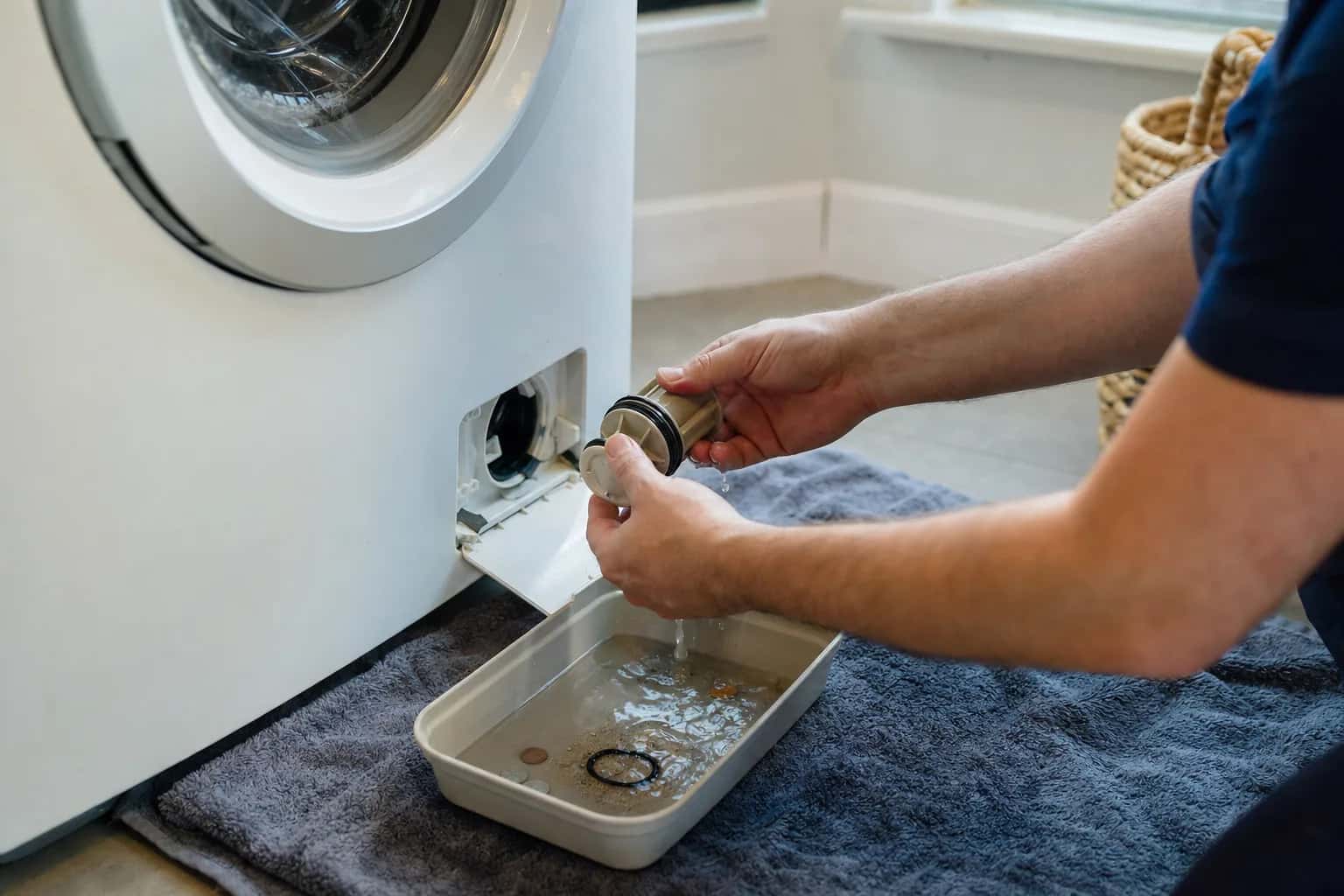
- Clean the drain pump filter (front-loaders). Most front-load washers have a small access door at the bottom front, and behind it is a filter that catches coins, hair ties, socks and sand. Put down towels and a shallow pan first, because the water in the tub comes out here. Unscrew the filter slowly, clear it, and screw it back in firmly.
- Cut the detergent. Too much soap, or regular detergent in a high-efficiency machine, makes suds that slow the drain and can make the washer pause, skip the spin or show a suds code. Use HE detergent and run an extra rinse to clear the suds.
- Reset the control. Unplug the washer for a minute, plug it back in and start a drain-and-spin cycle.
Drain hose specs by brand
- Whirlpool front-loaders: Whirlpool says the hose should go no more than 4.5 inches into the drainpipe or laundry tub, and should not be sealed in with tape; it should be loose yet secure.
- Samsung: Samsung says the hose should go at least 6 and no more than 8 inches into the standpipe or sink, without an airtight connection, sit at least 18 inches high (24 for a wash basin) and no higher than 96 inches (35 for a basin), with no extension kit.
- Other brands: the installation instructions in your owner's manual give the depth and height for your model.
How often to clean the filter
Samsung recommends cleaning its front-load pump filter at least once a month or about every 40 washes, whichever comes first, to help prevent odors and keep the washer draining properly.
How much detergent?
Whirlpool says to follow the detergent maker's dosage for your load size and soil level, because too much detergent can mean longer cycles, oversudsing, poor rinsing and poor cleaning. Concentrated HE detergents take less than you might expect, so read the label instead of filling the cap.
If the tub is full of water
Turn the washer off and unplug it. On a front-loader, drain it through the filter access above; some models have a small drain tube next to the filter that makes this easier. On a top-loader, bail out most of the water with a container, then lower the end of the drain hose into a bucket set below the level of the tub and let gravity do the rest. Keep towels handy either way.
Error codes that mean "drain"
Most washers flag a drain problem on the display. LG shows OE, Samsung shows 5C or 5E, and Whirlpool shows F9 E1. Codes vary by model, so check your manual, or see our guides to LG, Samsung and Whirlpool washer error codes.
On an LG front-loader, there is a quick pump test. LG says to run a spin-only cycle on High and listen during the first 15 seconds: a hum means the pump motor is running, so clean the filter; no hum means the drain pump needs service.
If the code comes back after you have cleaned the filter and checked the hose, the drain pump itself is the usual cause.
Won't drain: the parts
- Drain pump. It either jams on something that slipped past the filter or simply wears out. A washer not draining all the way, or draining slowly, often has a pump on its way out. You may hear it hum without moving any water.
- Water level sensor. If it tells the control the tub is empty or full when it is not, the control makes the wrong decision.
- Control board. Occasionally the board never tells the pump to run. We confirm this with tests before replacing a board.
When the filter is clear and the pump hums but moves no water, it is time for a technician to replace the drain pump.
Drains but won't spin
- Lid switch or door lock. A washer will not spin unless it knows the lid or door is locked, and worn lid switches and failed door locks are routine repairs. Please do not tape or bypass the switch; it is what keeps hands out of a drum spinning at high speed.
- Drive belt. On belt-driven machines, a stretched or broken belt means the motor runs but the drum barely turns.
- Motor coupling or clutch. On many direct-drive top-loaders, a plastic coupling between the motor and the transmission is built to break under overload. A slipping clutch leaves clothes wet.
- Shift actuator. Many newer high-efficiency top-loaders use one to switch between washing and spinning. When it fails, the washer may wash but never spin.
- Motor or control board. Less common, and always confirmed with tests first.
If the door stays locked after the cycle, see washer door won't unlock.
What washer repair costs in Atlanta
The diagnostic is $80 and is waived when you approve the repair. Most washer repairs start at $180 labor plus parts, and a typical washer repair on a standard brand runs $250 to $450 all in. Drain pumps, door locks, lid switches and belts sit in that range. Tub bearings and transmissions are the expensive ones and can exceed $500; on an older machine we will tell you honestly if replacing it makes more sense. Every repair carries our 60-day parts-and-labor warranty. See our pricing.
Keep it from happening again
- Clean the front-load pump filter about once a month.
- Empty pockets and shake the sand out of beach towels before they go in.
- Use HE detergent, measured to the detergent maker's directions for your load.
- Leave the front-load door open between loads so the drum and seal can dry.
Schedule a visit or read about our washer repair service. Prefer to talk? Call (470) 778-4087.
Sources
- Samsung: Samsung washing machine will not drain
- Whirlpool: F9 E1, front load washer
- LG: What is a front load washing machine OE error code?
- Samsung: How to clean your Samsung washer
- Whirlpool: Sd or 5d error code
How we write and check these guides: editorial policy. Spot an error? Email hello@atlantaappliancetechs.com.
About Atlanta Appliance Techs
Atlanta Appliance Techs is a locally owned appliance repair company serving Metro Atlanta, including washer repair in Atlanta. $80 diagnostic waived with the repair, 60-day parts-and-labor warranty, and gas, electric and induction appliances. More about us.