Washers
Washer Leaking From the Bottom? Where the Water Comes From
Washer leaking from the bottom? How to find where the water starts, from the hoses and door seal to the drain pump, plus what repair costs in Atlanta.
By Atlanta Appliance Techs · Published · Updated · 6 min read
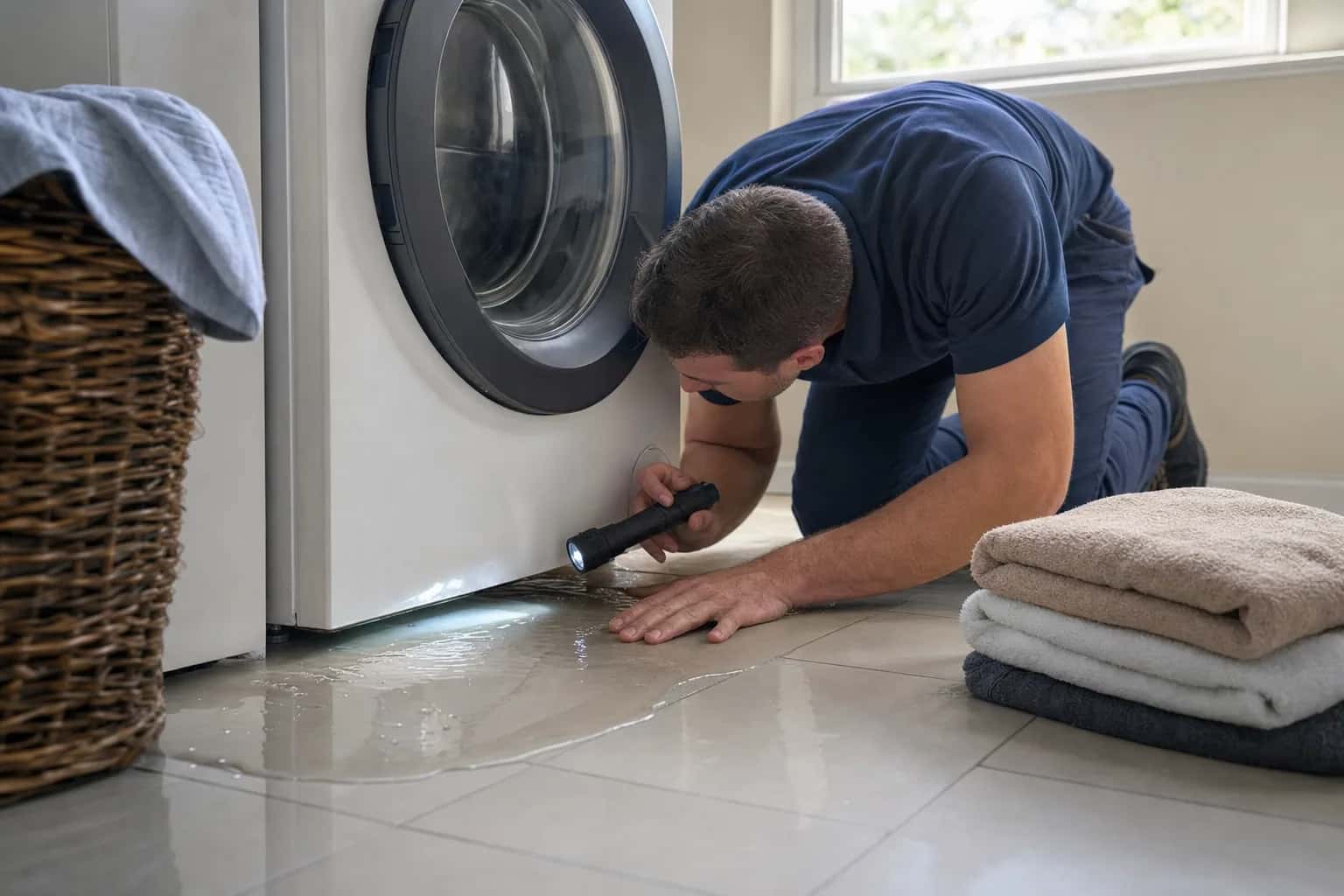
A washer leaking from the bottom is usually losing water from one of a handful of places: a supply hose, the drain hose or standpipe, the door seal on a front-loader, the drain pump or its filter cap, or a seal inside the machine. Water runs to the lowest corner, so a puddle at the front does not mean the leak is at the front. Finding where it starts is most of the job, and several of the fixes are ones you can make yourself.
Water and electricity do not mix. If the puddle has reached the outlet or the cord, switch off the breaker before you touch anything; Ready.gov warns not to touch electrical equipment if it is wet or if you are standing in water. Then turn off both water valves behind the washer, unplug it, and keep towels and a shallow pan handy before you open a filter or disconnect a hose.
Washer leaking from the bottom: find where it starts
- Dry everything. Mop the floor, then wipe under the front edge and along the back so you start from dry.
- Lay paper towels under the front, both sides and the back. Where they get wet first tells you more than where the puddle ends up.
- Run an empty cycle and watch. LG suggests a Rinse + Spin cycle to see where the leak starts. Note when the water appears: while filling points to the supply side; while washing, to the door seal, dispenser or tub; while draining or spinning, to the drain hose, standpipe or pump.
- Ask whether it happens every load. A leak that shows up only with big bedding loads or a heavy hand with detergent is a different problem from one that drips every cycle.
- Look behind with a flashlight, with the power and water off.
Leaking water from the back: inlet hoses and hose washers
The two fill hoses are under house water pressure whenever the valves are open, so a leak here can drip even when the washer is off.
- Hose washers. Whirlpool says both ends of the inlet hoses need hose washers (the rubber gaskets inside the fittings) and every connection must be secure.
- Worn rubber washers. LG says to inspect the rubber washers at each connection and replace them if they are worn.
- The hoses themselves. Check along each hose for cracks, punctures or damage. Whirlpool says a damaged hose needs to be replaced.
- Old hoses. Whirlpool says fill hoses should be replaced every five years.
- The water inlet valve. The part on the back of the washer where the hoses attach can crack and drip. That one is a repair.
Drain hose and standpipe
If the water shows up during the drain or spin, look here first.
- The drain hose. It should be free of kinks, cracks and splits. Samsung says the hose should go at least 6 and no more than 8 inches into the drain pipe, because an airtight connection creates a suction effect that causes siphoning.
- The standpipe. If water spills out of the top of the pipe the hose drains into, the house drain cannot keep up. Whirlpool says the sink and drainpipe must carry away no less than 17 gallons (64 L) of water a minute, and a clogged or slow standpipe backs up. That is a plumbing problem, and a plumber is the right call.
- A laundry sink. If the washer drains into a sink, check the sink's own drain and faucet too.
Front-load door seal leaking at the front
A front-loader's rubber door seal, or boot, holds the water in the drum. Water that runs down the front of the cabinet during the wash usually starts here.
- Something caught in the seal. Whirlpool says clothing items occasionally get stuck in or under the door seal, and that the seal's small drainage holes should be checked after each use so they are not blocked.
- Small debris. Samsung says to fold the seal back and look, because even a single strand of hair or a piece of thread can cause a leak.
- A torn or worn seal. Cracks and tears mean replacement. LG says a torn or damaged gasket needs a repair.
- The dispenser drawer. Whirlpool says a clogged dispenser can leak, the drawer must be completely closed, and single-dose packets belong in the drum before the clothes, never in the drawer.
Leaking underneath: the drain pump and filter cap
On most front-loaders, a small door at the bottom front hides the drain pump filter, often with a short drain tube and cap beside it.
- A loose filter or cap. LG says leaks at the drain filter usually come from a loose drain hose cap or a pump filter that is not seated or screwed in properly. Reseat both.
- A failing pump. A cracked pump housing or a worn pump seal drips under the washer during the drain. A pump that hums, drains slowly or leaks gets replaced. Top-loaders have their pump underneath too, and the same drain-time timing applies.
Tub seals and bearings
If the hoses, door seal, filter and pump are all dry but water still appears underneath during the wash or spin, the leak may be inside the cabinet: a hose or clamp between the tub and the pump, or, on a front-loader, the tub seal around the drive shaft. A failing tub seal lets water reach the drum bearing, and a roaring, rumbling spin usually follows. Hoses and clamps are routine repairs. Tub seals and bearings are the expensive ones, so read our repair-or-replace guide before you decide on an older washer.
Too many suds
Suds find a way out. Whirlpool says non-HE detergent, or more detergent than the manufacturer recommends, makes excess suds that can make a washer leak, and that "no splash" or easy-pour chlorine bleach contains a thickener that can do the same. Use HE detergent only and measure it.
To check for built-up residue, run an empty cycle with no detergent or other additives. Samsung says any suds you see then are coming from detergent residue.
An unlevel washer
Whirlpool's front-load leak checklist includes leveling: an uneven washer can leak. All four feet should sit firmly on the floor with no rocking. If yours bangs, walks or rattles during the spin, see washer shaking violently.
What usually fails
- Inlet hose or hose washer: drips at the back, sometimes with the washer off.
- Water inlet valve: a leak at the back where the hoses attach.
- Drain hose: water behind or beside the washer during the drain.
- Door boot: water down the front during the wash.
- Drain pump or filter cap: water under the front during the drain.
- Internal hose or clamp: water underneath while everything outside is dry.
- Tub seal and bearings: water underneath plus a roaring spin.
If the hoses and filter check out and you still cannot find it, have a technician trace the leak with the washer running. If the washer is also slow to drain or leaves clothes soaking wet, see washer not draining or spinning.
What it costs in Atlanta
The diagnostic is $80, and it is waived when you approve the repair. Washer repairs start at $180 plus parts, and a typical washer repair on a standard brand runs $250 to $450 all in; pumps, locks, lid switches, belts and valves fall in that range. Premium brands can run higher, and tub bearings can exceed $500. You get a written flat-rate estimate before any work begins. The repair can be finished on the first visit when the part is in stock, and if a part has to be ordered there is no trip charge for the return visit. Every repair carries our 60-day parts-and-labor warranty. See our pricing.
Schedule a visit or read about our washer repair service. Prefer to talk? Call (470) 778-4087.
Sources
- Whirlpool: Leaking from front, front load washer
- Whirlpool: Leaking from underneath or bottom, front load washer
- Samsung: Samsung washing machine is leaking
- LG: Why is my front load washing machine leaking?
- Whirlpool: Checking the fill hoses if the washer is not filling
- Ready.gov: Floods
How we write and check these guides: editorial policy. Spot an error? Email hello@atlantaappliancetechs.com.
About Atlanta Appliance Techs
Atlanta Appliance Techs is a locally owned appliance repair company serving Metro Atlanta, including washer repair in Atlanta. $80 diagnostic waived with the repair, 60-day parts-and-labor warranty, and gas, electric and induction appliances. More about us.