Washers
Washer Shaking Violently or Unbalanced Every Load?
Washer shaking violently in the spin cycle, walking across the floor or unbalanced every load? The fixes to try first, the parts that wear out, and costs.
By Atlanta Appliance Techs · Published · Updated · 6 min read
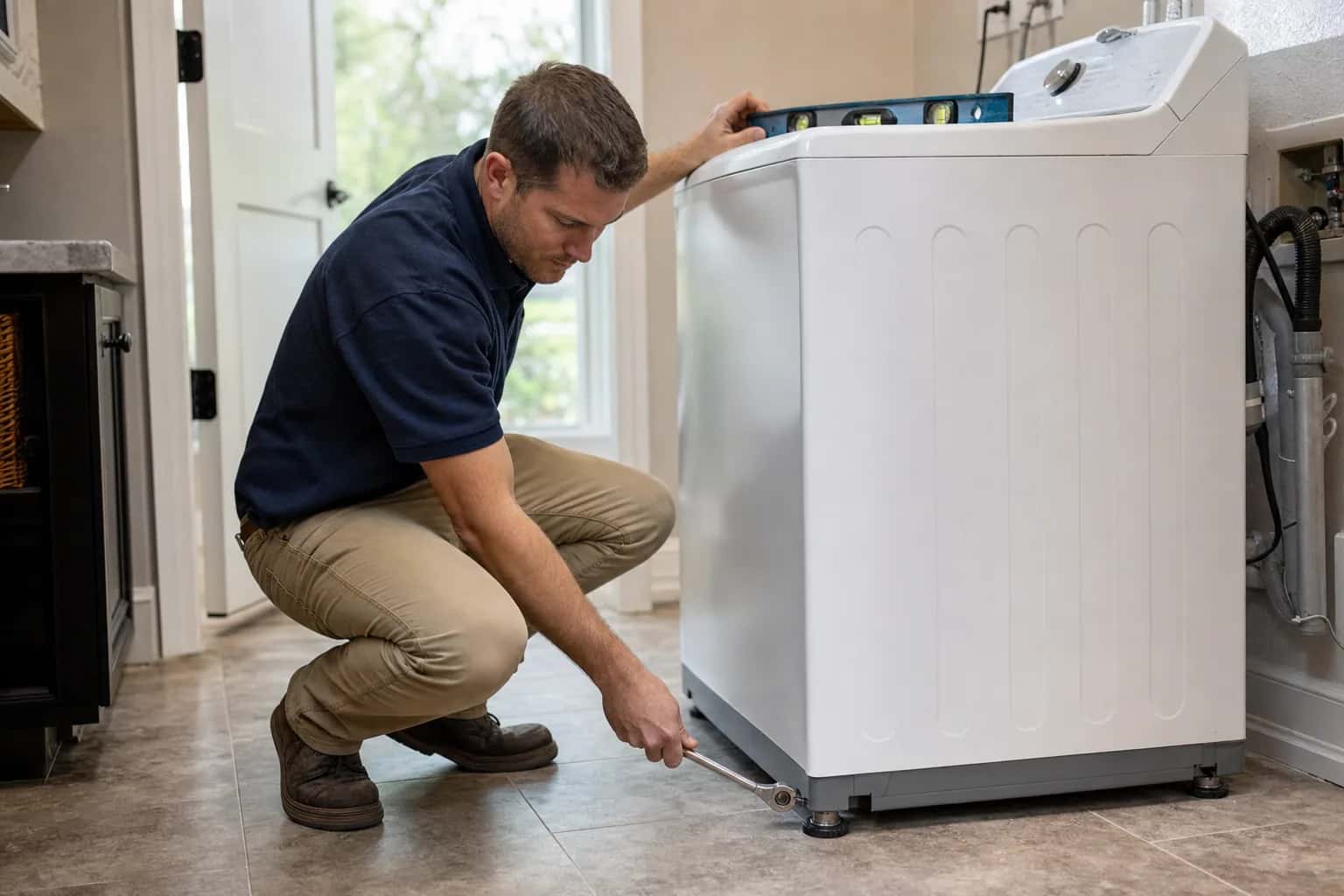
A washer shaking hard in the spin cycle usually has one of three simple causes: an unbalanced load, a washer that is not level, or, on a new front-loader, shipping bolts that were never removed. You can fix all three yourself. When a level washer with a normal load still shakes, bangs or roars, worn suspension parts or tub bearings are the usual cause, and that is a repair.
Safety first: if the washer is shaking violently, stop the cycle before it walks into the wall or strains its hoses and cord. Unplug it and turn off both water valves before you tilt it, reach underneath or pull it away from the wall.
Washer shaking? Checks you can do yourself
- Rebalance the load. Stop the cycle, open the washer and spread the laundry evenly. Whirlpool says clothing should move freely in the washer, so do not pack it tightly.
- Rock the washer. Grip the top and rock it front to back, then side to side. Whirlpool says the front and rear feet must be in firm contact with the floor.
- Level it. LG says to lay a level across the top and adjust the leveling feet until the washer is level from side to side and front to back.
- Lock the feet. Once all four feet are firm, tighten the lock nuts (Whirlpool calls them jam nuts) up against the base of the washer. A foot with a loose nut can creep as the washer vibrates.
- On a new front-loader, check the shipping bolts (see below).
- On a pedestal, Whirlpool says the mounting screws should be tight, the pedestal's feet firm on the floor, and the foot lock nut secure.
Unbalanced load every time
Load problems cause a lot of shaking, and they cost nothing to fix.
- Single bulky items. Whirlpool says to avoid washing single items, especially bulky ones, and to balance a single item with a few extra items.
- Load size. LG says its front-loaders perform best when the load is about two-thirds of the drum's capacity.
- Small loads and sheets. Samsung says small loads of 3 to 5 pounds tend to bunch on one side, so add a few items or lower the spin speed, and that sheets and other large items can tangle and should be redistributed by hand.
When a washer senses an unbalanced load, it slows down, tries to even things out and may stop with a code:
- Samsung shows Ub (also UE, U6 or Ur) and says the load is unbalanced in the tub. Ur means Unbalanced Load Retry: the washer adds water, tries to balance the load and tries the spin again.
- LG shows UE when the laundry has piled up on one side of the drum. Pause, spread the laundry evenly and restart.
Our guides to Samsung washer error codes, LG washer error codes and Whirlpool washer error codes cover the steps for each. Codes vary by model, so confirm yours in the owner's manual. If nearly every normal load ends in an unbalanced code on a level washer, the suspension is the likely cause.
Washer shaking violently during the spin cycle
Shaking is worst in the spin cycle because the drum is at full speed and any heavy spot gets flung outward. If the violent shaking happens only with comforters, rugs or a couple of towels, it is the load. If it happens with an ordinary mixed load on a level washer, or started suddenly and keeps getting worse, suspect worn parts. A washer that bangs its tub against the cabinet should not keep running, because the pounding wears other parts and can loosen hose connections.
Shipping bolts on a new front-loader
Front-loaders ship with bolts through the back that hold the tub still in transit. Whirlpool says all shipping materials must be removed for proper operation and to avoid excessive noise.
The stakes are real. LG says failing to remove the shipping bolts and retainers before use may cause severe vibration and noise that can lead to permanent damage to the washer.
Check yours before you reach for tools:
- Push on the drum. Samsung says that with the bolts removed, the drum feels like it is connected to springs, with a little give. If it feels like it is connected to a rock, with almost no give, the bolts are still in.
- Look at the back for the bolts. LG says to remove all of them from the rear with a suitable wrench and plug the holes with the caps provided. Keep the bolts in case you move.
- Check underneath. LG says its front-loaders ship with a foam block under the tub; with two people, tilt the washer back to check, and remove it if it is still there.
If a new washer ran for a while with the bolts in and still shakes after they are out, have it checked.
Washer walking across the floor
A washer that walks is telling you its feet are not all carrying weight. Repeat the rock test and tighten the lock nuts. Then look at the floor:
- Whirlpool says to check the floor for flexing or sagging, and not to install the washer on a raised wooden platform.
- LG says the washer must be level and installed on level, solid flooring.
- Samsung says the floor should be stable and free from damage, with about an inch of space between the washer, the dryer and the walls.
A wood-framed floor that flexes lets the washer bounce even when it is perfectly level. Stiffening a floor is a job for a contractor, not an appliance technician.
What usually fails
- Suspension rods and springs (top-loaders). The tub hangs from them. When they wear, the tub swings and bangs the cabinet with normal loads, and unbalanced codes become constant.
- Shock absorbers, dampers and springs (front-loaders). They control how far the drum moves. Worn ones let the drum knock and the cabinet rock, often with a thud as the spin starts.
- Tub bearings. A roaring or rumbling noise that grows louder over weeks, worst on the spin, is the classic sign. It often follows a leaking tub seal, so check for water underneath too; see washer leaking from the bottom.
- Leveling feet. A stripped or broken foot will not hold its height.
Worn dampers and suspension rods are a routine fix, and replacing worn suspension parts usually costs far less than a new washer.
What it costs in Atlanta
The diagnostic is $80, and it is waived when you approve the repair. Washer repairs start at $180 plus parts, and a typical washer repair on a standard brand runs $250 to $450 all in. Premium brands can run higher, and tub bearings and transmissions can exceed $500. You get a written flat-rate estimate before any work begins, the repair can be finished on the first visit when the part is in stock, and every repair carries our 60-day parts-and-labor warranty. See our pricing.
Repair or replace?
Suspension parts are usually worth replacing. Bearings on an older front-loader are a closer call. InterNACHI's life-expectancy chart puts a washing machine at 5 to 15 years with regular maintenance, and a bearing job can exceed $500. A common rule of thumb is to replace when the repair costs more than half of a comparable new washer and the machine is past the midpoint of its expected life. Our repair-or-replace guide and our guide on whether a washer is worth repairing walk through the math.
Schedule a visit or read about our washer repair service. Prefer to talk? Call (470) 778-4087.
Sources
- Whirlpool: Vibration, walking or off balance, front load washer
- LG: Troubleshooting vibration issues
- LG: How to resolve a UE (unbalanced) error, front load washer
- Samsung: Samsung washing machine is shaking too much
- Samsung: Washing machine error codes
- InterNACHI: Standard estimated life expectancy chart for homes
How we write and check these guides: editorial policy. Spot an error? Email hello@atlantaappliancetechs.com.
About Atlanta Appliance Techs
Atlanta Appliance Techs is a locally owned appliance repair company serving Metro Atlanta, including washer repair in Atlanta. $80 diagnostic waived with the repair, 60-day parts-and-labor warranty, and gas, electric and induction appliances. More about us.