Washers
Washer Not Agitating? Top-Load Washer Fixes
Washer not agitating? How to tell normal HE impeller motion from a real fault, the top-load checks to try first, the parts that fail, and repair costs.
By Atlanta Appliance Techs · Published · Updated · 6 min read
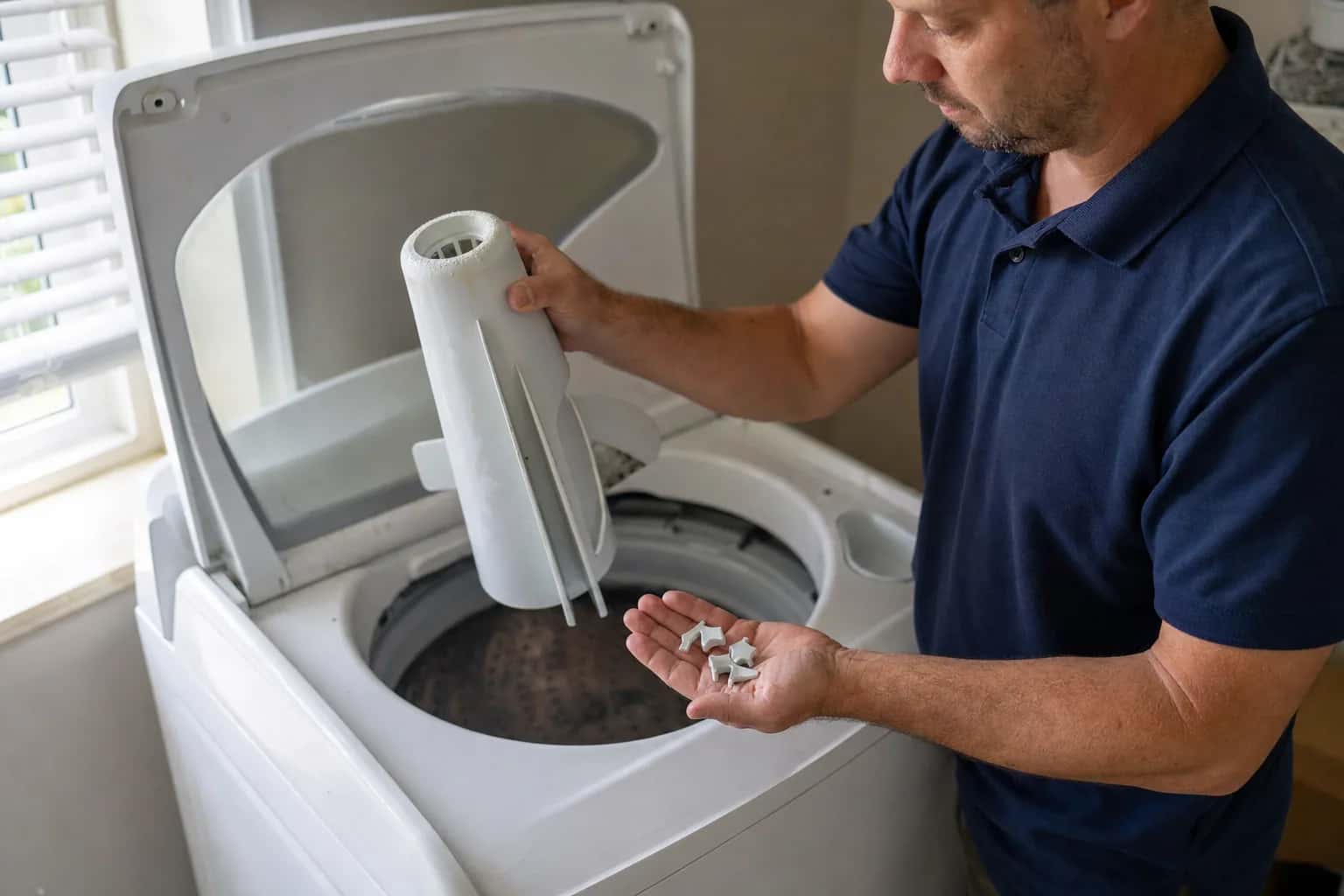
A washer not agitating usually comes down to one of three things: it is a high-efficiency model moving the clothes exactly as designed, the washer does not detect that the lid is closed and locked, or a part between the motor and the agitator has worn out. On a top-load washer, a few minutes of watching and one hand test usually tell you which, and most of the parts involved are inexpensive.
Unplug the washer before you reach into the tub or pull the cap off the agitator. Please never tape, jumper or bypass the lid switch or lid lock; it is what keeps hands out of a moving basket.
First, is it really not agitating?
Many newer top-loaders have no tall agitator post at all. They have an impeller, a low disc or cone in the bottom of the basket. Samsung explains the difference: an agitator rotates back and forth so the clothes rub against each other, while an impeller rotates to create a water current in the center of the drum that makes the clothes rub against each other. The motion is gentler, the water is lower, and on some cycles the load barely seems to move. That is normal.
A few other normal pauses look like a washer that has stopped agitating:
- Sensing the load. GE says that on newer washers it takes about 20 to 30 seconds for the machine to sense the load and engage the drive system.
- Soak. GE notes that some of its models have soak cycles of 15 or 30 minutes before the main wash.
- Rebalancing. Whirlpool says that when a top-load HE washer detects an off-balance load, it tries to self-correct by refilling and gently rotating back and forth, which can look like weak agitation.
- The wrong cycle for the load. Whirlpool recommends its Bulky cycle for larger loads and oversized items. A comforter on a normal cycle may barely turn over.
Washer not agitating? Checks you can do yourself
- Watch a whole wash. Stay through the fill and the first several minutes. Note whether you hear the motor, whether anything moves and whether a light flashes.
- Check the cycle. Make sure it is not set to soak or a delayed start, and was not paused.
- Fix the load. Whirlpool says to place items in loose heaps evenly around the basket, mixing heavy and light pieces. One heavy item, like a comforter, can keep a top-loader stuck rebalancing.
- Close the lid firmly and clean the lock. Whirlpool says detergent and lint buildup at the lid lock or on the lock striker (the piece on the lid that fits into the lock) can keep the lid from locking, and that you may need to hold Start for up to 3 seconds. Wipe both with a soft, damp cloth.
- Reset the power. Unplug the washer for a few minutes, plug it back in and start a new cycle. Our guide on how to reset a washing machine has the brand steps.
- Try the GE motor reset if it applies. On GE top-loaders with the HydroWave wash system (select models made from 2011 through 2015), GE documents a motor reset: unplug the washer for 1 minute, plug it back in, then lift and lower the lid 6 times within 12 seconds, raising it at least 2 inches and closing it fully each time.
- Do the hand test. With the washer unplugged and the basket empty, try turning the agitator by hand. On a two-piece agitator, the top section should turn freely in one direction and catch in the other. If the whole agitator spins freely with no resistance at all, the connection to the drive shaft has probably failed.
Top-load washer lid switch and lid lock
Every top-load washer has to confirm the lid is closed before it agitates. GE says its washers will not agitate or spin with the lid up, although many models still fill and drain and the timer still advances. That is why a bad lid switch fools people.
The lid itself carries part of the switch. GE notes that if the lid switch probe or the magnet on the lid is missing or damaged, the washer will not agitate or spin even with the lid closed.
Newer top-loaders lock the lid with a small motorized lock. Whirlpool says a flashing lid lock light means the lock did not move into the lock position, the lock motor could not be powered, or something kept the lid from closing completely. If cleaning the striker does not fix it, the lid lock assembly is the usual repair.
Agitator not moving: agitator dogs and the drive block
On a two-piece agitator, the upper section is driven by a ring of small plastic cogs, usually called agitator dogs. They let the top turn one way and grab the other, which pulls clothes down into the water. When the dogs wear out, the bottom of the agitator moves but the top does not, and clothes float on top without turning over. They are an inexpensive part.
The agitator itself sits on a splined drive block over the transmission shaft. When the splines strip, the shaft turns but the agitator does not, and it spins freely by hand. Sometimes the agitator bolt has simply worked loose.
Direct-drive washers and the motor coupling
Older Whirlpool direct-drive top-loaders connect the motor to the transmission through a motor coupling: two plastic drive forks with a rubber piece between them. The coupling is built to break under overload, which protects the motor and transmission. When it breaks, you hear the motor run, but the washer neither agitates nor spins. It often lets go after an overloaded wash, and it is an inexpensive repair.
Shift actuator, clutch and belt
- Shift actuator. Many newer high-efficiency top-loaders use a shift actuator to switch between washing and spinning. When it fails, the washer may spin but never agitate, or agitate but never spin, and it often shows an error code.
- Clutch or mode shifter. Other designs change modes mechanically. A worn clutch or a failed shifter leaves the washer stuck in one mode.
- Belt. Belt-driven top-loaders use a belt between the motor and the transmission. A stretched belt slips, so the agitator barely moves and you may smell hot rubber; a broken belt means the motor runs and nothing else does.
What usually fails
- Lid switch or lid lock. The washer fills, then nothing moves; the lid light may flash.
- Agitator dogs. The bottom of the agitator moves; the top does not.
- Drive block. The motor runs; the agitator spins freely by hand.
- Motor coupling. The motor runs or hums; no agitation and no spin, often right after a heavy load.
- Shift actuator or clutch. Stuck in spin or stuck in wash, often with an error code.
- Belt. Weak or no agitation, sometimes with a burning rubber smell.
- Motor, timer or control. Silence when it should be agitating. The control is the priciest part, so we test the simpler parts first and confirm a control failure before replacing it.
Most of these are inexpensive parts, and top-load washer repair for a lid switch, coupling or set of dogs can be finished on the first visit when the part is in stock. If the washer also leaves water in the tub or skips the spin, start with washer not draining or spinning.
What it costs in Atlanta
The diagnostic is $80 and is waived when you approve the repair. Washer repairs start at $180 labor plus parts, and you get a written flat-rate estimate before any work begins. Typical washer repairs run $250 to $450 all in on standard brands; lid switches and belts are toward the low end, while a transmission can run past $500. The repair can be finished on the first visit when the part is in stock, and every repair carries our 60-day parts-and-labor warranty. See our pricing.
Repair or replace?
InterNACHI's life-expectancy chart puts a washing machine at 5 to 15 years with regular maintenance. A lid switch, coupling or set of agitator dogs is worth fixing on almost any washer. A transmission is different: if the washer is past the middle of its life and the repair costs more than half of a comparable new washer, replacing it usually makes more sense. Our repair-or-replace guide walks through the math.
Schedule a visit or read about our washer repair service. Prefer to talk? Call (470) 778-4087.
Sources
- Samsung: Agitator vs. impeller washer
- GE Appliances: Top load washer, fills but will not agitate
- GE Appliances: Top load washer, HydroWave motor reset
- Whirlpool: Lid lock flashing, washer
- Whirlpool: Top load HE washer is unbalanced or overloaded
- InterNACHI: Standard estimated life expectancy chart for homes
How we write and check these guides: editorial policy. Spot an error? Email hello@atlantaappliancetechs.com.
About Atlanta Appliance Techs
Atlanta Appliance Techs is a locally owned appliance repair company serving Metro Atlanta, including washer repair in Atlanta. $80 diagnostic waived with the repair, 60-day parts-and-labor warranty, and gas, electric and induction appliances. More about us.