Refrigerators
Why Is My Fridge Leaking Water? Inside and on the Floor
Fridge leaking water under the crisper drawers or onto the floor? What causes it, the safe checks to try first, the parts that fail, and what repair costs.
By Atlanta Appliance Techs · Published · Updated · 6 min read
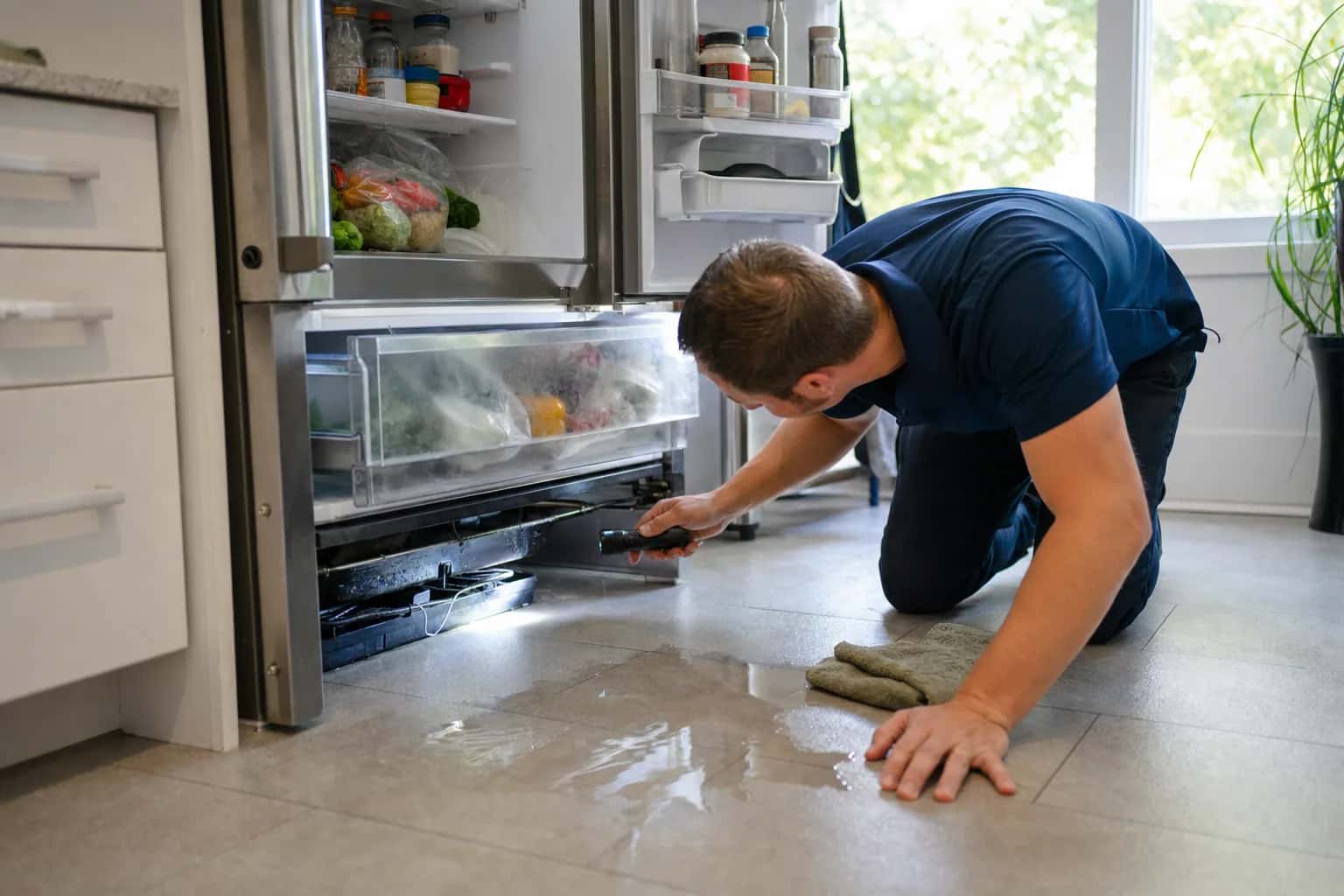
A fridge leaking water is usually one of two things: meltwater from the automatic defrost is not reaching the drain pan, or supply water is escaping from the line, valve or filter that feeds the ice maker and dispenser. Water inside the fridge, under the crisper drawers or frozen at the bottom of the freezer usually means a clogged defrost drain. A puddle on the floor with a dry interior points to the water supply, the filter, the drain pan or a fridge that is not level. Several of those you can check yourself in a few minutes.
A quick safety note first: water and electricity share the space under and behind a refrigerator. If the puddle has reached the outlet or the cord, switch off the breaker before you touch anything. Unplug the refrigerator before you remove the kick plate or pull it away from the wall, and wipe up as you go, because a wet kitchen floor is easy to slip on.
Fridge leaking water? Checks you can do yourself
- Find where the water starts. Dry everything with towels and check again in a few hours. Water inside the fridge, water under the freezer and water that appears from behind the refrigerator are three different problems.
- Level it, with a slight tilt back. Refrigerators are designed to lean back a little so the doors swing shut on their own. Whirlpool notes that a fridge that is not level can let too much water collect at the front of the drain pan and spill onto the floor. On Samsung models, the front should rest on the leveling legs with the front wheels off the floor; your owner's manual shows how to raise the front.
- Reseat the water filter. Take it out, look at the filter and its housing for cracks, and reinstall it until it locks firmly in place. Incorrect, incompatible or overdue filters can drip at the filter head, so use the filter your manual specifies.
- Inspect the supply line. Unplug the refrigerator and close the water shut-off valve, which may be under the sink, in a basement or behind the fridge. Ease the refrigerator out and look along the line and at the connection on the back for drips, splits or a loose fitting. Whirlpool says tears or breaks mean the line needs replacing.
- Look for the drain pan under the kick plate. With the refrigerator still unplugged, remove the kick plate (the grille at the bottom front) and look underneath with a flashlight. You are looking for a pan that is full to the rim, cracked or knocked out of position. On many models the pan is fixed in place or reached only from the back, so do not force it.
- Test the door seals. Close each door on a dollar bill in a few spots. If the bill slides out with no resistance, the gasket is not sealing. Clean the gaskets with warm soapy water and try again.
Leaking water inside the fridge
Every frost-free refrigerator melts the frost off its cooling coil on a regular schedule. That meltwater runs into a drain hole, usually at the bottom back of the freezer, and down a tube to a pan under the refrigerator, where it evaporates. When the drain clogs with food debris or freezes shut, the water backs up and shows up in a few telltale places:
- Under the crisper drawers. Whirlpool notes that a clogged drain tube leads to water puddling inside the refrigerator compartment, and that it can eventually leak through the bottom door seal onto the floor.
- As a sheet of ice at the bottom of the freezer. LG says a sheet of ice on the freezer floor is likely caused by a blocked drain line, and that if it forms again after a manual defrost, the drain needs a technician.
A clogged defrost drain is a common cause of water inside a refrigerator. A few owner's manuals show how to flush the drain yourself, but on most models it sits behind the freezer's back panel, and LG strongly recommends a trained technician because the repair means taking the refrigerator apart.
Whirlpool's guidance is similar: water building up inside or beneath the fridge calls for a professional inspection of the drain line. When a technician clears a drain, they should also look for the reason it clogged, because a drain that keeps freezing shut often points to a defrost heater or drain heater problem. Once it is clear, keep food from covering the drain hole at the back of the freezer.
Not every drop inside is a clog. Water can also form when a door is not fully shut in humid weather, when hot food goes straight into the fridge, or when a container has leaked.
Leaking water from the bottom of the fridge
If the inside is dry but there is water on the floor, work from the back of the refrigerator forward:
- The water inlet valve. On refrigerators with an ice maker or dispenser, this valve usually sits at the bottom back and opens to send water to the ice maker and the door. A cracked valve leaks behind the fridge; one stuck open can flood the ice maker, and the overflow ends up on the floor.
- The supply line and fittings. Incorrectly installed water lines can leak at their connection points, and loose valve connections and nuts, or damage from a move, make leaks more likely. If the leak is in your home's plumbing before it reaches the refrigerator, a plumber is the right call.
- The filter housing. A cracked housing keeps leaking even with a new filter.
- The drain pan. A cracked or displaced pan leaks every time the refrigerator defrosts.
- A frozen water tank. On models with a water tank behind the vegetable bins, GE says a frozen tank will often split and leak water onto the fresh-food floor, which needs service.
- An unlevel fridge, as in check 2 above.
Door gaskets and condensation in humid weather
On a humid afternoon, a few beads of water on the door edges or along the gaskets are not unusual. Heavy sweating, frost inside the freezer or water dripping from the door edge is different: it usually means a gasket that is torn, hardened or not sealing, or a door that is not closing all the way. Extra humid air getting in also means extra frost to melt, which adds to the load on the drain. Our Atlanta humidity maintenance checklist covers gasket care, and refrigerator door won't close covers the door itself.
What usually fails
- Defrost drain clog. Water under the crisper drawers or ice on the freezer floor. The technician clears and flushes it, and if it keeps freezing, tests the drain heater and defrost heater.
- Water inlet valve. Water at the bottom back, or an ice maker that overflows. Its other classic symptom is covered in ice maker not making ice.
- Drain pan. A dry interior but a fresh puddle at the front every day or two.
- Filter housing. A leak at the filter that a new filter does not stop.
- Door gasket. Sweating, frost and water at the door edge.
- Defrost heater, thermostat or sensor. Frost that keeps building on the back wall of the freezer; see freezer not freezing and refrigerator not cooling but freezer works.
When the leak comes from inside, it is a job for a technician to clear the defrost drain and find out why it clogged.
What it costs in Atlanta
The diagnostic visit is $80, and it is waived when you approve the repair. Repairs start at $180 labor plus parts, and you get a written flat-rate estimate before any work begins. On standard brands, most refrigerator repairs run $250 to $500 in total; see the typical totals on our pricing page. If a part has to be ordered, there is no trip charge for the return visit. Every repair carries our 60-day parts-and-labor warranty.
Repair or replace?
A refrigerator leaking water is rarely a reason to replace it; drains, valves, pans and gaskets cost a fraction of a new unit. For an older refrigerator with other problems, our repair-or-replace guide walks through the math.
Schedule a visit or read about our refrigerator repair service. Prefer to talk? Call (470) 778-4087.
Sources
- Whirlpool: How to Fix a Refrigerator That Is Leaking Water
- Whirlpool: What to Do if There is Water on the Floor
- LG: Refrigerator Frost Buildup
- Samsung: Frost forms in the Samsung freezer, refrigerator, or ice bucket
- GE Appliances: Refrigerator - No Water from Dispenser
- Whirlpool: How to Level the Refrigerator
How we write and check these guides: editorial policy. Spot an error? Email hello@atlantaappliancetechs.com.
About Atlanta Appliance Techs
Atlanta Appliance Techs is a locally owned appliance repair company serving Metro Atlanta, including refrigerator repair in Atlanta. $80 diagnostic waived with the repair, 60-day parts-and-labor warranty, and gas, electric and induction appliances. More about us.