Refrigerators
Refrigerator Not Cooling but Freezer Works? Here Is What Is Wrong
Freezer cold but the fridge warm? It is usually a frosted coil, a stopped fan, a stuck damper or a bad sensor. How to tell which, and what to do tonight.
By Atlanta Appliance Techs · Published · Updated · 8 min read
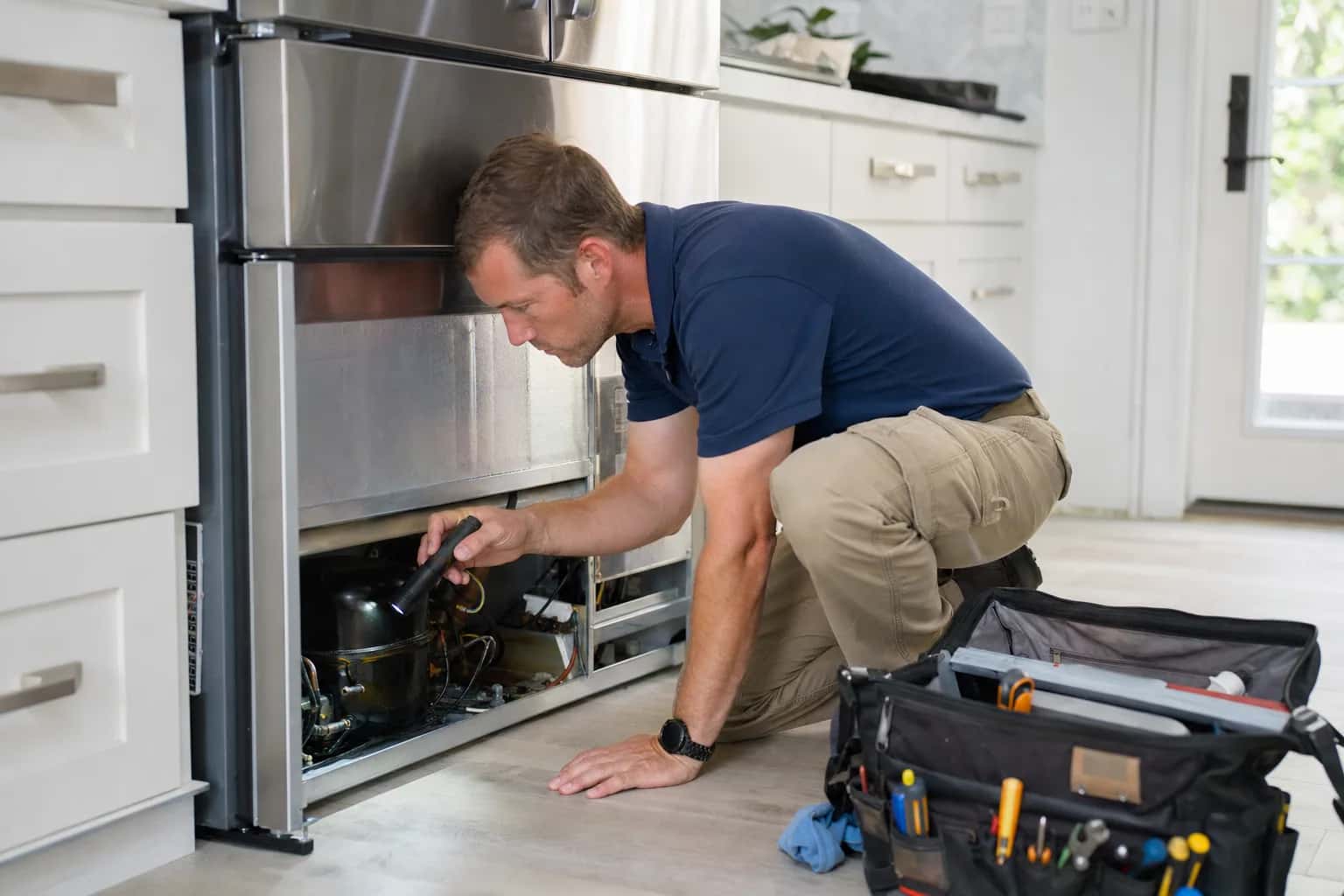
If your refrigerator is not cooling but the freezer works, the refrigerator is still making cold; it just is not getting that cold air to the fresh-food side. In most refrigerators the cold is made in the freezer and blown into the fridge through vents, so four things usually cause it: frost smothering the cooling coil after a defrost failure, an evaporator fan that has stopped, a damper stuck closed, or a temperature sensor that reads wrong. Blocked vents and a few settings problems cause the same symptom, and those you can fix yourself tonight.
Quick answer
| Symptom | Likely cause | Safe to check yourself? | Typical fix |
|---|---|---|---|
| Frost or ice on the freezer's back wall, fridge warm | Defrost system failure | Yes: look at the back wall of the freezer | Replace the defrost heater, thermostat, sensor or control |
| No air moving behind the freezer panel, or a whine that stopped | Evaporator fan motor | Yes: listen with the door closed | Replace the fan motor |
| No frost, fan running, no cold air at the fridge vent | Damper stuck closed or vents blocked | Yes: clear food away from the vents | Clear the vents or replace the damper |
| Fridge temperature far from the setting, everything else normal | Temperature sensor (thermistor) or control | Partly: check with a thermometer | Replace the sensor or control |
| Fridge warm right after someone changed the setting | Settings, or not enough time | Yes | Reset the setting and wait 24 hours |
How a refrigerator moves cold air
Most refrigerators have one cooling coil, the evaporator, behind the back wall of the freezer. Whirlpool describes it as a shared cooling system in which cold air is generated in the freezer and pushed into the fresh-food section through vents. A fan pulls air across the coil, sends it through supply vents into the fridge, and return vents carry it back to the coil.
On many models, a damper sits in that path and meters how much freezer air reaches the fridge. GE explains that the fresh-food control regulates the damper between the two compartments by controlling how much cold air flows in.
So when anything interrupts the airflow, the freezer stays cold, because it sits right next to the coil, while the fridge slowly warms. Some refrigerators use a separate evaporator for each compartment instead. On those, a fan or defrost problem on the fresh-food side warms only the fridge, and the same checks still apply.
First, protect your food
Put an appliance thermometer on a middle shelf. USDA says a refrigerator set at 40°F or below will protect most foods, and that bacteria grow fastest between 40°F and 140°F. Once the fridge climbs above 40°F, move milk, meat, leftovers and other perishables to the freezer or to a cooler with ice.
If food sat warm for hours, USDA's rule after a power outage is a useful yardstick: perishables such as meat, poultry, fish, eggs, milk, soft cheeses and leftovers should be thrown out after more than 4 hours without refrigeration. Never taste food to decide. When in doubt, throw it out.
Checks you can do yourself
- Check the settings. Whirlpool recommends about 37°F for the fridge and 0°F for the freezer, and waiting at least 24 hours between adjustments. A fresh-food control bumped to its warmest setting can keep the damper nearly shut.
- Clear the vents. Items crowded against the back and side walls can block the vents that distribute chilled air, and blocked return vents alone can leave the fridge warm. Check the freezer side too, since that is where the cold air starts its trip.
- Make sure the doors seal. Close each door on a dollar bill in a few places and tug. You should feel some resistance; if the bill slides out freely, clean the gasket with warm soapy water and test again.
- Look at the freezer's back wall. Pull out the baskets or shelves. A thick layer of frost or ice on the back panel, or ice bulging around its edges, points to a defrost failure.
- Listen for the fan. With the door closed (or the door switch pressed), you should hear air moving behind the freezer panel while the refrigerator runs. GE notes that the compressor and fans do not run during a defrost cycle, so if all is quiet, wait an hour and listen again before you decide the fan has failed.
- Feel the fridge vent. While the compressor hums, hold your hand near the air inlet in the fridge, usually high on the back wall. Cold air means the path is open; no air at all with a cold freezer points to the fan or the damper.
The four usual causes
1. A defrost system failure
Every frost-free refrigerator melts the frost off its evaporator on a schedule. GE says its timed systems start a defrost every 8 to 15 hours depending on the model, for about 25 minutes and up to 45.
Other brands run on similar schedules; LG's refrigerators defrost every 4 to 16 hours.
If the defrost heater, the defrost thermostat or sensor, or the control that runs them fails, the frost never melts. It keeps building until the coil becomes a solid block of ice that air cannot pass through. Whirlpool notes that ice freezing against the evaporator coils obstructs airflow, and that a freezer accumulating ice quickly should be checked by a professional. The fridge, which is the last stop on the airflow path, is usually the first place you notice it.
2. The evaporator fan motor
If the fan stops, nothing pushes cold air into the fridge. The freezer may stay cold for a while because it surrounds the coil, but it often starts to struggle too. Whirlpool says a faulty evaporator fan can make the freezer loudly click, buzz or hum. A fan that whined for a few weeks and then went silent is a classic sign.
3. A damper stuck closed
The damper is a small door, motorized on many newer models, between the freezer air path and the fridge. If it fails closed or its gears strip, the fan can run perfectly and still send no cold air into the fridge. There is no frost and the freezer is fine; the fridge just never gets its share.
4. A temperature sensor or control
The control relies on a sensor (thermistor) to know how warm the fridge is. If the sensor reads wrong, the control may never open the damper or run the fan long enough. Whirlpool's check is simple: leave a glass of water on the top shelf for 24 hours, then measure it with a cooking thermometer. If it is more than 2 degrees off the set temperature, the sensor may be faulty.
Which part is it? A step-by-step flow
- Is the freezer near 0°F while the fridge is above 40°F? If both are warm, this is not an airflow problem; see why is my fridge not cooling.
- Is there heavy frost on the freezer's back wall? Yes points to the defrost system. Go to the manual defrost below.
- No frost: do you hear the fan with the door closed? No fan sound after waiting out a possible defrost cycle points to the evaporator fan motor.
- The fan runs: is cold air coming out of the fridge vent? No air at the fridge vent, with nothing blocking it, points to the damper or the air path.
- Air is flowing: does the glass-of-water test match the setting? If it is more than 2 degrees off, suspect the sensor or the control.
- Did a manual defrost fix it for a few days, then the fridge warmed again? That confirms a defrost part has failed, and the frost will keep coming back until it is replaced.
What to do tonight
Move perishables into the freezer or a cooler with ice. If you found heavy frost and no technician can come soon, a manual defrost buys time. LG's procedure is a good model:
- Unplug the refrigerator and remove the food and the ice.
- Leave the doors open for at least 8 hours, with towels in and around it to catch the meltwater.
- Dry the inside, plug it back in and allow 24 to 48 hours for normal temperatures.
USDA warns against using any electrical heating device, ice pick, knife or other sharp object to remove frost, because it can damage the inner lining. Let it melt on its own.
If a technician is already on the way, consider leaving the frost in place. GE recommends keeping a refrigerator plugged in when it needs service so the symptoms do not disappear, and a frosted coil tells the technician a lot. If the frost returns after you defrost it, the fix is the failed part, and it is worth booking a technician to replace the defrost heater or fan rather than defrosting every few days.
What the repair costs
The diagnostic visit is $80, and it is waived when you approve the repair. Labor starts at $180 plus parts, and you get a written flat-rate estimate before any work begins. On standard brands, most refrigerator repairs run $250 to $500 in total, parts and labor; see the typical totals on our pricing page. Defrost heaters, defrost thermostats, fan motors, dampers and sensors are usually the smaller parts. Control boards cost more, which is why we test the cheaper parts before we quote a board. Every repair carries our 60-day parts-and-labor warranty.
Repair or replace?
This is usually a repair worth making. When the freezer still freezes, the compressor and the sealed system, the most expensive parts of a refrigerator, are doing their job. If your refrigerator is older or has had other problems, our guide to whether it is worth repairing a refrigerator walks through the numbers.
Schedule a visit or read about our refrigerator repair service. Prefer to talk? Call (470) 778-4087.
Sources
- Whirlpool: Not Cooling - Refrigerator Section
- GE Appliances: Refrigerator - Adjusting Temperature Controls
- GE Appliances: Refrigerator - Automatic Defrost System
- LG: Refrigerator Frost Buildup
- Whirlpool: 7 Freezer Problems and How to Help Fix Them
- USDA FSIS: Refrigeration and Food Safety
How we write and check these guides: editorial policy. Spot an error? Email hello@atlantaappliancetechs.com.
About Atlanta Appliance Techs
Atlanta Appliance Techs is a locally owned appliance repair company serving Metro Atlanta, including refrigerator repair in Atlanta. $80 diagnostic waived with the repair, 60-day parts-and-labor warranty, and gas, electric and induction appliances. More about us.