Dryers
Dryer Leaking Water? Why Condensation Runs Back Down
Dryer leaking water? Why vent condensation runs back into the dryer, how to rule out the washer, steam and ventless causes, and what you can check first.
By Atlanta Appliance Techs · Published · Updated · 8 min read
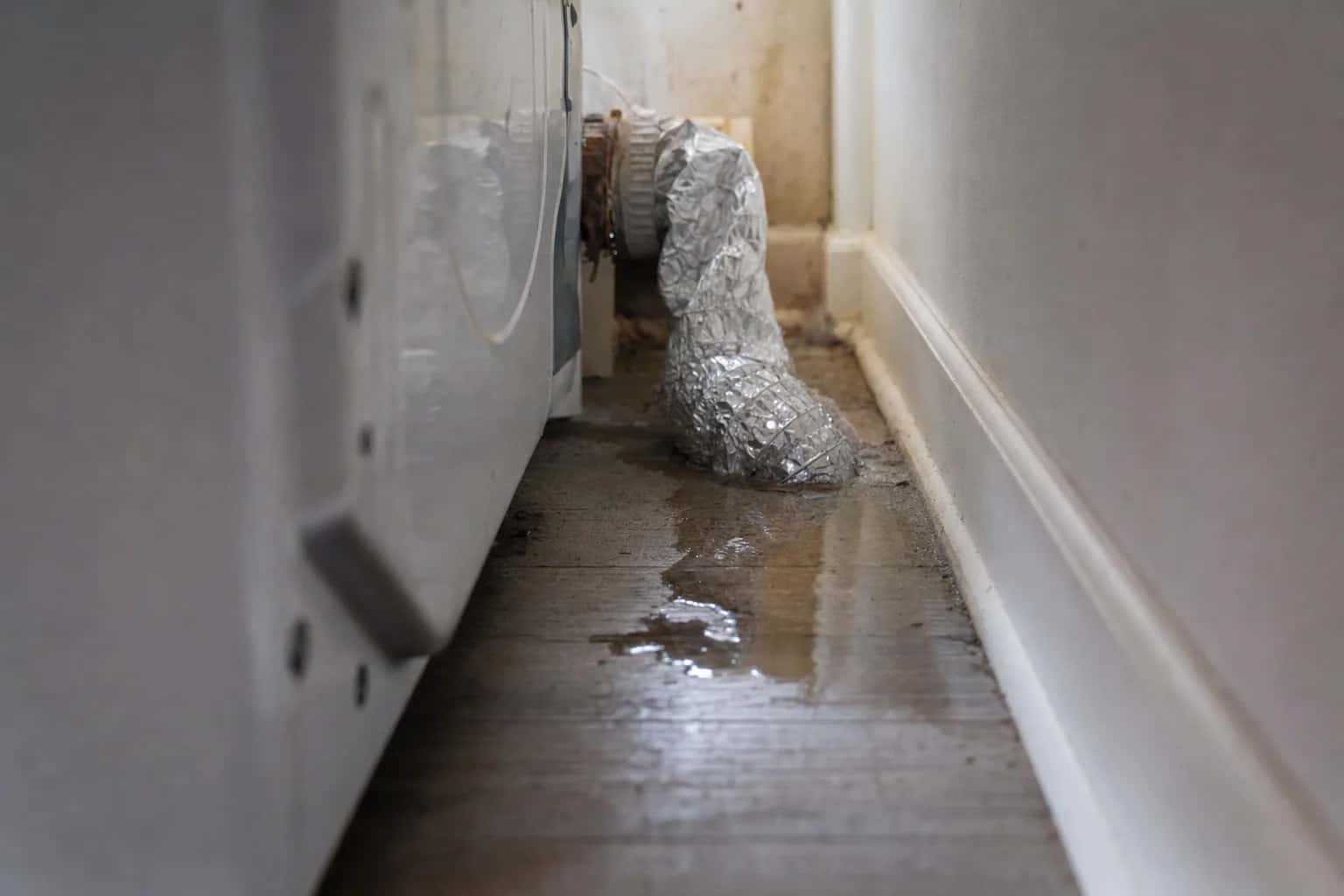
A dryer leaking water is rarely a leak inside the dryer itself. On a standard vented electric dryer, the water is usually condensation from the exhaust vent running back down into the machine, and the next most likely source is the washer beside it. Steam dryers, which connect to a water line, and ventless condenser or heat-pump dryers, which collect water on purpose, have a few causes of their own.
Water and 240 volts do not mix. If water has reached the outlet, the cord or the floor around the dryer, switch off the dryer's breaker before you touch anything. The CPSC warns not to touch wet appliances that are still plugged in. Unplug the dryer before you pull it out from the wall.
We repair gas and electric dryers. If you ever smell gas, leave the house and call 911 or your gas utility from outside, and do not touch light switches.
Quick answer
| Symptom | Likely cause | Safe to check yourself? | Typical fix |
|---|---|---|---|
| Puddle behind or under a vented dryer, worse on long cycles | Condensation running back down the vent | Yes: check the duct and joints behind the dryer | Clean, re-slope or reroute the vent |
| Wet, pasty lint at duct joints | Restricted vent holding moisture | Yes: look at the connections | Vent cleaning by a professional |
| Puddle shows up while the washer drains or spins | The washer, not the dryer | Yes: run each machine alone | Washer hose, pump or seal repair |
| Drips at the back of a steam dryer | Fill hose or hose washers | Yes: check both hose ends | Tighten or replace the hose or washers |
| Water in the drum when steam is off | Water inlet valve leaking through | No | Replace the inlet valve |
| Water under a ventless dryer | Tank not seated, kinked drain hose, or internal drain fault | Partly: tank and hose | Reseat the tank, or service |
Dryer leaking water? Checks you can do yourself
- Make it safe. Switch off the breaker or unplug the dryer, and dry the floor completely.
- Run each machine alone. With the dryer off, run the washer through a drain and spin and watch the floor. Then, with the washer off, run the empty dryer on a heated cycle for 15 minutes. The machine that makes the puddle is the one to fix.
- Check the vent connection. With the dryer unplugged, pull it out and look at the duct where it joins the dryer and the wall. Drips, rust streaks or wet, pasty lint at a joint mean water is coming down the vent.
- Look for sags and crushed duct. A duct that droops between the dryer and the wall holds water in the low spot, and thin foil or plastic duct crushes easily. Replace it with 4-inch rigid or semi-rigid metal duct.
- Check the outside hood, if you can reach it from the ground. The flap should open freely while the dryer runs. GE says never to install a screen or grid of any kind in or over the exhaust duct. Do not climb onto the roof to check a roof cap.
- Clean the lint screen. A clogged screen slows the air and adds to condensation.
- On a steam dryer, check the water hose. Look for drips at both ends of the fill hose.
- On a ventless dryer, check the water tank and drain hose. Make sure the tank or drawer is pushed fully into place and the drain hose is not kinked.
Where the water comes from, by dryer type
| Dryer type | Where its water is supposed to go | Where a leak usually starts | First thing to check |
|---|---|---|---|
| Standard vented electric | Out the vent as moist air | Condensation in a long, cool or sagging duct | Duct joints and low spots behind the dryer |
| Steam dryer | Into the drum as a short spray during steam cycles | Fill hose ends, hose washers, inlet valve | Both ends of the fill hose |
| Ventless condenser or heat pump | Into a removable tank or out a drain hose | Tank not seated, kinked or blocked drain hose | Tank position and drain hose |
| Any dryer beside a washer | Nowhere: the dryer is dry | The washer's hoses, pump or seals | Run the washer alone and watch |
Why condensation comes back down the vent
The air leaving a dryer is hot and full of water from the clothes. As it travels through the duct it cools, and when it cools enough, that water condenses on the inside of the duct. Whirlpool says that when the moisture is not released outside, it can accumulate inside the dryer or the venting and cause water puddles on the floor, usually behind the dryer.
How your vent is routed makes a big difference. A short duct straight out a nearby wall gives the air little time to cool. A vent that runs up through an attic to a cap on the roof, often a long way from the laundry room and with several elbows, gives it plenty. Attics swing between hot afternoons and cooler nights and winters, and the longer the run, the more the air cools and slows before it gets out. Slow air also drops lint, which holds even more moisture. On a vent that rises to the roof, whatever condenses has only one way to go: down the pipe and back into the dryer, where it drips out underneath.
GE says venting straight up through the roof is acceptable, but venting through an outside wall is better. The same restriction is why a dryer takes forever to dry, so if you are seeing both, look hard at the vent.
Vent sags, dips and a blocked roof cap
Water collects wherever the duct has a low spot: a sag in flexible duct behind the dryer, a dip where the duct crosses attic framing, or a joint that has pulled apart. GE notes that plastic flexible vent hoses collapse more easily, reducing airflow and possibly collecting water. At the far end, a cap clogged with lint, a bird's nest or a screen keeps the air from leaving, which means more condensation in the pipe. A cap whose flap no longer closes can also let wind and rain in.
The CPSC recommends cleaning the dryer vent and exhaust duct periodically and checking the outside vent while the dryer runs to make sure exhaust air is escaping.
Long runs and roof vents are not a do-it-yourself job; have them inspected and cleaned by a dryer vent cleaning professional. Samsung recommends cleaning the exhaust vent once or twice a year, and with a long run or a roof vent, the more frequent end of that range makes sense.
Every dryer repair includes an airflow check at the machine, so you will know whether the vent is restricted. We do not clean duct runs; if yours needs it, we will tell you and recommend a vent cleaning professional.
Dryer leaking water from the bottom
Water on the floor under the front or sides of a vented dryer usually traces back to one of three things: condensation that ran down the vent and out through the dryer, a steam dryer's water supply, or water that actually came from the washer and ran under the dryer. Check 2 above separates them.
Is it really the washer?
Washers and dryers sit side by side, so a washer leak often shows up under the dryer. If the puddle appears while the washer drains or spins, or the floor is wet on the washer side first, the washer is the source: a drain hose, a pump, a door boot or a tub seal. Our guide to a washer leaking from the bottom walks through it.
Condenser and heat-pump dryers
Ventless dryers do not send moisture outside, so they collect it. Whirlpool explains that a ventless dryer condenses the moisture from the air in the drum and either collects it in a removable drawer or sends it out through a drain hose, and that the details vary by make and model, so check your manual. After you empty a tank, push it fully back into place. If it drains to a standpipe or sink, make sure the hose is not kinked, crushed or pushed in farther than your manual allows. If the tank is seated, the hose is clear and water still escapes, the dryer needs service.
Steam dryers
Steam dryers connect to a water faucet with a fill hose. Whirlpool says both ends of the inlet hoses need their hose washers and all connections must be tight. A few drops can be normal, since steam can condense on the door and drip when you open it, especially with small loads. Water dripping into the drum when no steam cycle is running is different; it usually means the water inlet valve is leaking through, and that needs a repair.
What usually fails
- The vent. Not a dryer part, but the most likely cause of a vented dryer leaking water. It needs cleaning, re-sloping or rerouting, not a new dryer.
- Steam water inlet valve or fill hose. Water in the drum when steam is off, or drips at the back.
- Ventless drain parts or tank. Water under a condenser or heat-pump dryer even with the tank seated.
- The washer. A drain pump, hose, door boot or tub seal next door.
What it costs in Atlanta
The diagnostic is $80 and is waived when you approve the repair. Dryer repairs start at $180 labor plus parts, and you get a written flat-rate estimate before any work begins. Typical dryer repairs run $230 to $380 all in on standard brands. If the leak turns out to be a steam valve or a ventless drain part, electric dryer repair in Atlanta covers condenser and heat-pump models too. Many repairs can be finished on the first visit, and every repair carries our 60-day parts-and-labor warranty. See our pricing.
Schedule a visit or read about our dryer repair service. Prefer to talk? Call (470) 778-4087.
Sources
- Whirlpool: Dryer Vent may be Blocked or Restricted
- GE Appliances: Dryer Installation Information for Exhaust Ducting
- Whirlpool: Leaking During Steam Cycle
- Whirlpool: What is a ventless dryer?
- CPSC: Overheated Clothes Dryers Can Cause Fires (Safety Alert)
- CPSC: Flood victims, steps to prevent CO poisoning, electrocution and fires
How we write and check these guides: editorial policy. Spot an error? Email hello@atlantaappliancetechs.com.
About Atlanta Appliance Techs
Atlanta Appliance Techs is a locally owned appliance repair company serving Metro Atlanta, including dryer repair in Atlanta. $80 diagnostic waived with the repair, 60-day parts-and-labor warranty, and gas, electric and induction appliances. More about us.