Ovens & Ranges
Oven Not Heating Up or Not Preheating? Electric Oven Checks
Electric oven not heating up, not preheating or not getting hot enough? Safe checks from the 240-volt breaker to the bake element, what fails, and repair costs.
By Atlanta Appliance Techs · Published · Updated · 8 min read
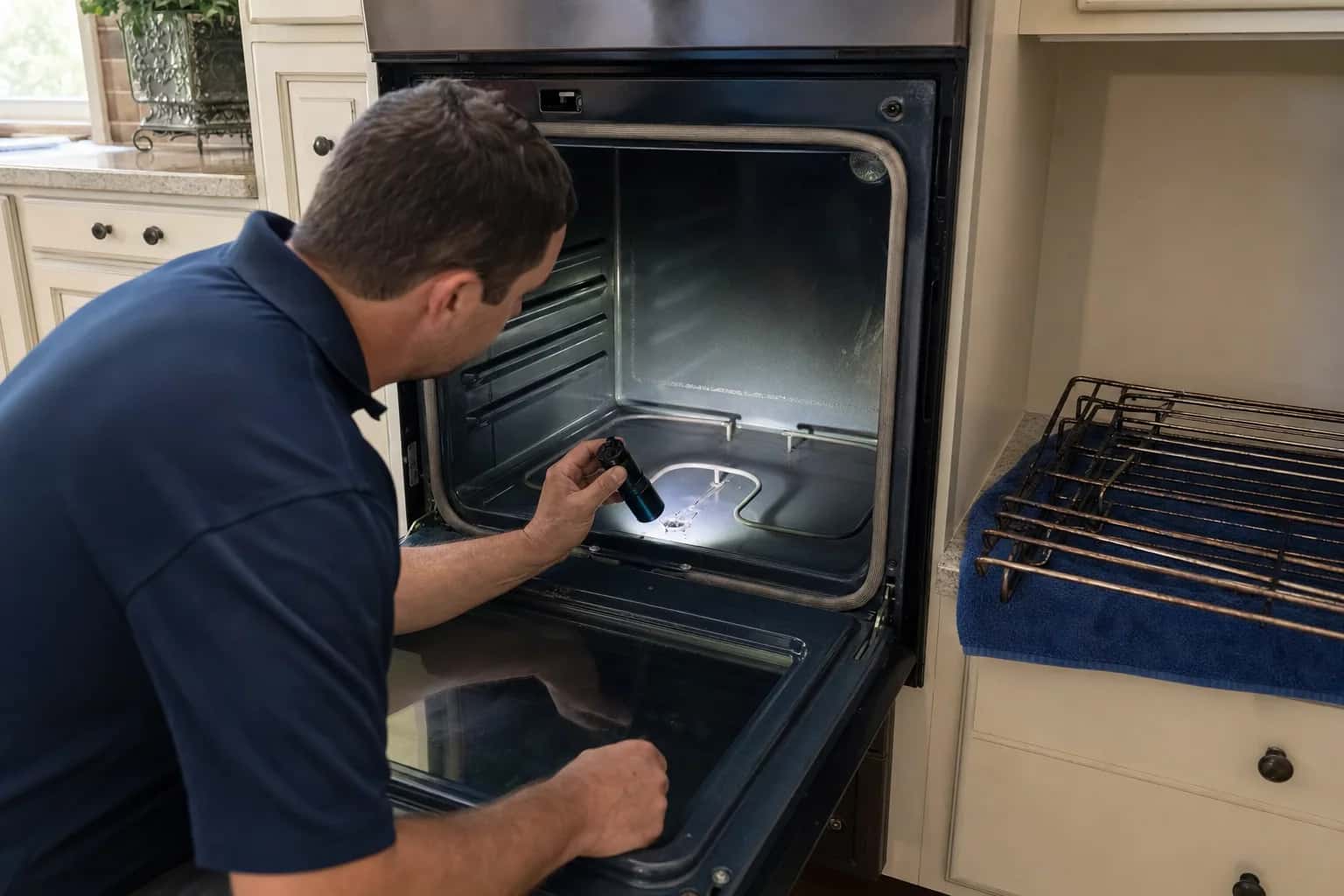
An electric oven that will not heat up, or takes forever to preheat and never quite gets there, usually comes down to one part: the bake element, the temperature sensor, a relay on the control, or a problem with the 240-volt power supply. Most of these are routine repairs. First, though, spend five minutes on the checks below, because plenty of ovens that seem broken are really stuck on a setting, a lock or a tripped breaker.
Checks you can do yourself
Let the oven cool first, and switch off the breaker before you touch an element or remove any panel.
- Make sure the controls are not locked. A control lock shuts off the keypad so the oven cannot be turned on by accident. GE's fault code list calls this Child Lockout and shows it as LOC; other brands use a padlock icon. Your owner's manual shows how to unlock it.
- Check for Sabbath or demo mode. Both can keep the display lit while the oven stays cold. Whirlpool says demo mode shows messages such as "Try the Product" or "Showroom Mode"; follow the prompts on the display or the manual to exit.
- Cancel any delayed start. A bake set on Delayed Start will not heat until its start time. Whirlpool's fix is to cancel the control and restart the bake.
- Check the breaker. An electric range or wall oven runs on 240 volts through a double-pole breaker, two handles tied together. Switch it fully off, then back on; a breaker that has tripped can look almost on. If it trips again, leave it off and call. The next section explains why the clock can work while the oven stays cold.
- Reset the control. Leave the breaker off for one minute, then switch it back on, as GE recommends for an oven that will not come on.
- Look at the bake element. With the power off, look at the heavy metal loop on the oven floor. GE says to inspect the lower element for cracks or breaks, and a cracked or broken one has to be replaced. A blister or burned spot means the same thing. Many newer ovens hide this element under a flat floor panel, so you may not be able to see it.
- Try broil. If the top element glows on broil but the oven will not bake, the problem is in the bake circuit. If neither works, suspect the power supply, a thermal fuse or the control.
- Test the temperature fairly. An oven swings above and below the setting as it cycles, so one thermometer reading can mislead. GE suggests a simple bake test with a tube of canned biscuits instead.
Clock works but the oven stays cold: a lost 240-volt leg
An electric range gets its 240 volts as two 120-volt "legs" from a double-pole breaker. The clock, display and oven light usually run on 120 volts, while the bake and broil elements need both legs. Lose one leg and the display can look perfectly normal while the oven heats weakly or not at all.
A leg can be lost in a few ways:
- One side of the double-pole breaker has tripped or is failing. A breaker that is wearing out can stop passing power on one side without looking tripped.
- A loose or burned connection. That can be at the breaker, at the range outlet, or at the terminal block on the back of the range where the power cord or cable connects.
- A damaged power cord.
What you can safely do is the full reset above: breaker all the way off, then firmly back on. If the oven still does not heat, or you see scorch marks at the outlet or smell something hot behind the range, stop there. Do not test 240-volt wiring yourself. Checking the breaker and supply is a job for a licensed electrician, and checking the range's own terminal block and wiring is a job for an appliance technician.
Electric oven not heating properly
When a bake element fails, GE explains, it usually breaks the circuit and the oven simply stops heating. Occasionally it shorts against its outer sheath instead, rupturing the metal with a brief burst of sparks; the breaker may trip, or the element stops working and leaves a burning smell.
GE recommends not using the oven once the bake or broil element has failed, so if you saw sparks, switch off the breaker until it is replaced. A new element is one of the more routine fixes, and electric oven repair in Atlanta includes checking the wires and terminals behind it, since a shorted element can scorch them.
If the element looks fine, the other suspects are:
- The temperature sensor, the thin probe on the back wall of the oven. A sensor that reads high tells the control the oven is already hot.
- A relay on the control board that no longer switches power to the element.
- A thermal fuse, a one-time safety device that cuts power when the oven overheats, often during a self-clean cycle.
- The lost 240-volt leg described above.
Several of these also bring up an error code; see our guides to GE oven error codes and Whirlpool oven error codes.
Oven not preheating or taking forever
A slow preheat is often the early stage of the same failures. On many electric ovens the broil element helps during preheat, so an oven with a dead bake element can still creep toward temperature while scorching the tops of food. An oven running on one leg of its supply preheats painfully slowly, if at all.
The supply voltage matters too. Some apartments and condos supply 208 volts instead of 240, and an element running on 208 volts puts out noticeably less heat, so preheat takes longer even when nothing is broken.
A worn door gasket lets heat escape around the door. With the oven cool, look for tears, flat spots or gaps in the seal. GE says a torn gasket should be replaced by a service technician.
Oven not getting hot enough
If the oven heats but food takes longer than the recipe says, confirm it with the bake test above. Two settings can make a healthy oven look cool:
- Convection conversion. GE says many convection ranges and wall ovens automatically lower the set temperature by 25 degrees when you use convection, for better convection results.
- Temperature adjustment. Many ovens let you adjust the temperature slightly yourself; GE's owner's manuals cover it under "Adjust the Oven Thermostat".
If the oven is off by more than the adjustment allows, or drifts again after you adjust it, the temperature sensor is usually the cause, and it can be replaced. Our guide to oven not holding temperature goes deeper.
Oven not working but the stove is
If the cooktop works but the oven does not, that pattern is a useful clue. The cooktop and the oven are separate circuits inside the range, and GE notes that a failed oven element does not affect the surface burners.
Because the cooktop elements also run on 240 volts, burners that heat normally suggest the supply is reaching the range. That points inside the oven circuit: the bake element, the sensor, a relay or the thermal fuse. If the burners are acting up too, see electric stove burner not working.
Gas ovens: the igniter and the gas valve
If your oven is gas, its heating problems usually involve the glow-bar igniter or the gas safety valve, and we repair both. GE gives a check you can do: set the oven to Bake and look through the door for a red glow near the back bottom. If no glow appears, GE says the glow-bar, the oven controls or another electrical part may be at fault. An igniter can also glow and still be too weak to open the gas valve, so a glowing igniter with no flame points to the igniter too.
Before you book, GE suggests two more checks: switch the breaker off for one minute and back on to reset the control, and make sure the gas shutoff valve to the range is open. On a range whose burners work but the oven does not, GE notes the regulator valve may have been bumped off during installation; the top burners still work with that valve off, but the oven will not. Beyond the appliance's own shutoff, the gas piping is work for a licensed plumber or gas contractor.
If you smell gas, do not touch light switches; leave the house and call 911 or your gas utility from outside, and never work on gas lines, valves or fittings yourself. Atlanta Gas Light's 24-hour emergency line is 877-427-4321.
What usually fails
- Bake element. No heat on bake, or visible damage.
- Broil element. No heat on broil, and on some models a slower preheat.
- Temperature sensor. Temperatures well off, or a sensor error code.
- Control board or relay. The element is good but gets no power.
- Thermal fuse. Dead during or right after a self-clean cycle.
- Supply connection or terminal block. One leg of the 240-volt supply missing, often with scorch marks.
What it costs in Atlanta
For freestanding ranges, the diagnostic is $80 and repairs start at $180 plus parts. Built-in wall ovens and double ovens take longer to reach, so the diagnostic is $120 and repairs start at $250 plus parts. On standard brands, typical all-in repairs run $230–$450 for a range and $330–$550 for a wall oven; premium brands run higher. The diagnostic is waived when you approve the repair, you get a written flat-rate estimate before work begins, and the repair carries our 60-day parts-and-labor warranty. If the part is in stock, the repair can usually be finished on the first visit. See our pricing.
Repair or replace?
Elements, sensors, relays and fuses are worth repairing even on an older range, and wall ovens are expensive to replace because the new one has to fit the cabinet. A failed control board on an older model whose parts are discontinued is the main exception; our repair-or-replace guide walks through the math.
Schedule a visit or read about our oven repair service. Prefer to talk? Call (470) 778-4087.
Sources
- GE Appliances: Range and wall oven, oven will not come on
- GE Appliances: Oven heating element failure
- GE Appliances: Electric range, oven does not heat but burners do
- GE Appliances: Oven temperature is not correct
- GE Appliances: Oven fault codes
- Whirlpool: Nothing is working (electric range)
- GE Appliances: Gas range and wall oven, oven will not come on
- GE Appliances: Gas range, oven does not heat but the burners heat
How we write and check these guides: editorial policy. Spot an error? Email hello@atlantaappliancetechs.com.
About Atlanta Appliance Techs
Atlanta Appliance Techs is a locally owned appliance repair company serving Metro Atlanta, including oven & cooktop repair in Atlanta. $80 diagnostic waived with the repair, 60-day parts-and-labor warranty, and gas, electric and induction appliances. More about us.