Ovens & Ranges
Oven Not Holding Temperature? Calibration and Sensor Fixes
Oven not holding temperature, running hot or cold, or swinging wildly? The normal swings, how to test and calibrate it, and the parts that usually fail.
By Atlanta Appliance Techs · Published · Updated · 6 min read
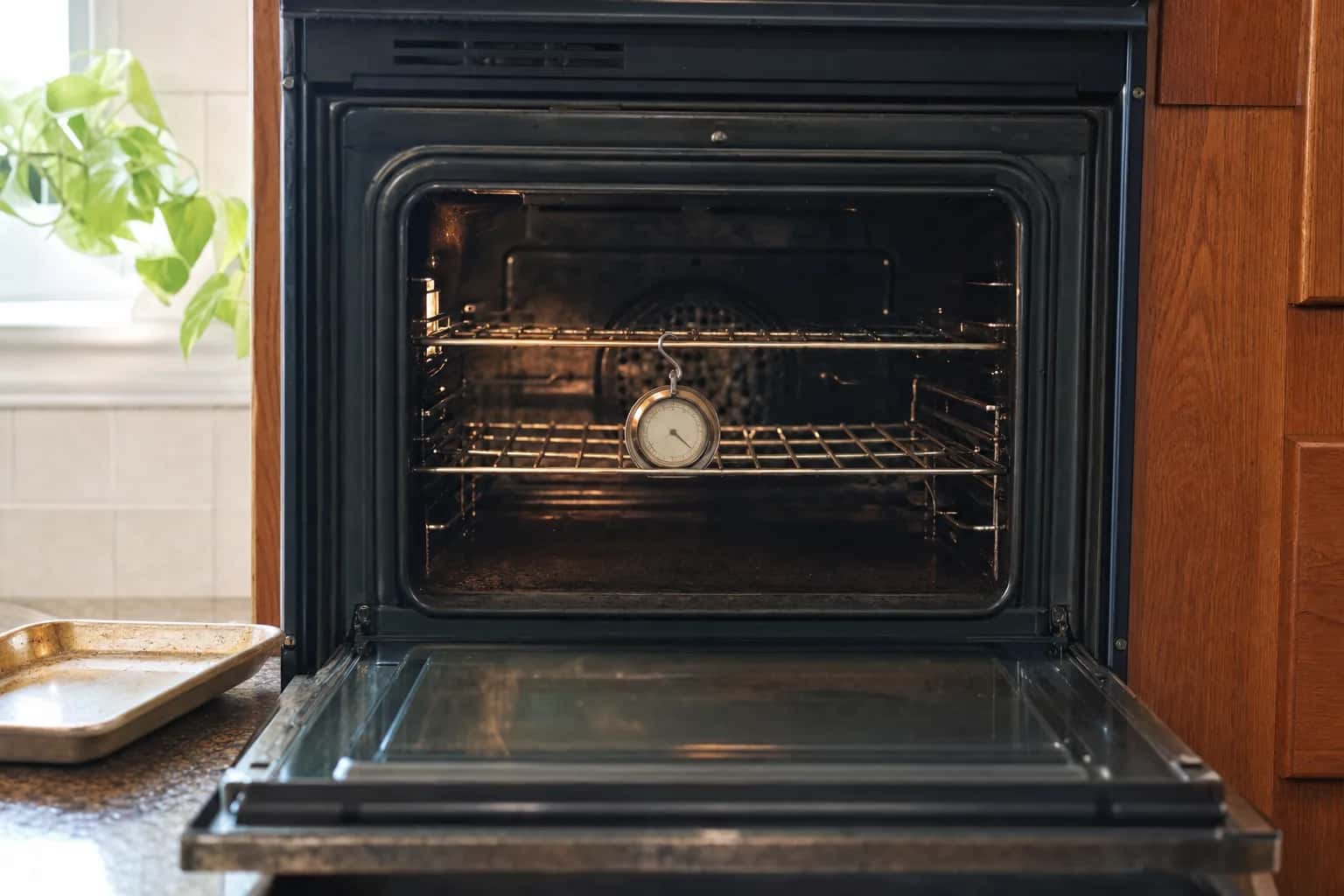
An oven not holding temperature is often doing exactly what it was designed to do: every oven cycles its heat on and off, so the temperature inside rises and falls around the setting. GE says a swing of about 30 degrees above and below the set temperature is normal in most cases. The real problems are an oven that averages well off the setting, swings much wider, or suddenly starts burning or undercooking food, and those usually come down to a sensor, a heating element, the door gasket or the control.
Normal temperature swings
An oven does not hold one steady temperature. It heats until it passes the setting, shuts the heat off, and turns it back on when the temperature drops below the setting, aiming for the right average. GE puts the normal swing at about 30 degrees either way in most cases, for a total swing of 60 degrees, by design. So an oven set to 350°F can read anywhere from about 320°F to 380°F at a given moment and still be healthy.
That is why a single glance at a thermometer can make a good oven look broken. Convection can fool you too. GE notes that ranges and wall ovens with convection baking typically have a Convection Conversion or Auto Recipe Conversion feature that automatically sets the temperature 25 degrees lower, so a lower number on the display may be the oven doing what it was set to do.
Oven not holding temperature? Checks you can do yourself
Let the oven cool, and switch off the breaker before you touch an element or remove any panel.
- Preheat fully. Wait for the preheat signal before the food goes in. GE points out that pies, cakes and biscuits have such short cooking times that skipping preheat can make a big difference in the results.
- Keep the door closed. Every opening lets heat out, and GE notes that opening the door frequently increases the cooking time.
- Give the air room. Leave space around pans so heat can circulate. Whirlpool says not to cover a whole rack with foil, because air must be able to move freely.
- Check the racks. GE says racks installed backward can keep the door from sealing or closing properly.
- Inspect the door gasket. With the oven cool, look along the seal around the oven opening for tears, flat spots or missing sections. A torn gasket lets heat escape, and GE says it should be replaced by a service technician.
- Run a bake test. GE recommends the "biscuit test": bake a tube of canned biscuits exactly as the package says, since they are consistently formulated. If they are done and evenly browned in the stated time, the oven is accurate enough.
- Look at the elements. With the breaker off, check the bake and broil elements for breaks, blisters or cracks; GE says a cracked or broken bake element has to be replaced.
- Calibrate if it is consistently off. See below.
Testing with an oven thermometer
GE says oven thermometers are not always the best way to check an oven, because opening the door and where the thermometer sits both affect the reading, and because the oven temperature cycles above and below the setting anyway.
If you do use one, use it over time rather than trusting one reading. Leave it on the center rack, keep the door closed, note the highest and lowest readings you can see through the window over 20 to 30 minutes after preheat, and look at the midpoint between them. A midpoint close to the setting means a healthy oven. A midpoint far off, or swings much wider than 30 degrees either way, is worth a closer look.
How to calibrate your oven
Most electronic ovens let you nudge the temperature up or down yourself. The steps and the limits are in your owner's manual; on GE models, look for the section called "Adjust the Oven Thermostat". Older ovens with a dial may have an adjustment on the back of the temperature knob or need a technician.
A few rules make calibration work:
- Adjust in small steps, then repeat the bake test before you adjust again.
- Adjust only for a steady error. If the oven is a little cool every time, calibration helps. If it is fine one day and off the next, the sensor or control is the likely cause.
- Know when to stop. If the oven is off by more than the adjustment range allows, or drifts again after you adjust it, calibration is the wrong fix.
Oven slow to preheat or never reaching temperature
Some slow preheats are normal. Extra racks left inside take time to heat, larger ovens take longer, and a cold kitchen adds a few minutes. Supply voltage matters too: some apartments and condos supply 208 volts instead of 240, and an element on 208 volts puts out noticeably less heat.
A preheat that suddenly takes much longer than it used to is a different story. It is a classic early sign of a failing bake element, or of a range that has lost one leg of its 240-volt supply; see oven not heating up.
Oven running hot or swinging too far
- The temperature sensor is the thin rod on the back wall of the oven. As it drifts, the control misjudges the temperature. GE says its F3 and F4 codes usually mean the oven sensor needs to be replaced; see GE oven error codes.
- A relay on the control switches the element on and off. A relay that sticks closed can keep heating past the setting; GE's F2 code means the oven temperature has exceeded a preset threshold. If the oven keeps heating with the controls off, switch off the breaker and leave it off until it is repaired.
- The convection fan spreads heat evenly. If it stops, convection bakes come out uneven, with hot and cold spots.
A sensor is a small part that bolts to the back wall and plugs into a harness, so it is one of the faster oven repairs. If your oven drifts again after calibration or shows a sensor code, you can have the temperature sensor tested and replaced; a technician should check its wiring and connector at the same visit, because a damaged wire can mimic a bad sensor.
What usually fails
- Temperature sensor. The oven runs consistently hot or cold by more than calibration can fix, or shows a sensor code.
- Bake element. Slow preheat, pale bottoms and sometimes burned tops.
- Broil element. Slow preheat on models that use it to help preheat.
- Control relay. Runaway heat, or heat that cuts out partway through a bake.
- Door gasket or hinges. Heat escaping around the door, or a door that does not close flush.
- Convection fan motor. Uneven convection baking, often with a new noise.
What it costs in Atlanta
For freestanding ranges, the diagnostic is $80 and repairs start at $180 plus parts. Built-in wall ovens and double ovens take longer to access, so the diagnostic is $120 and repairs start at $250 plus parts. On standard brands, typical all-in repairs run $230–$450 for a range and $330–$550 for a wall oven; premium brands run higher. The diagnostic is waived when you approve the repair, and you get a written flat-rate estimate before any work begins. Sensors and gaskets sit at the lower end, and if the part is in stock the repair can usually be done on the first visit. Every repair carries our 60-day parts-and-labor warranty. See our pricing.
Repair or replace?
A sensor, gasket or element is almost always worth replacing, even on an older oven. For an older oven with several problems at once, our repair-or-replace guide walks through the math.
We repair gas, electric and induction ovens and ranges. For a gas oven that will not light, see oven not heating up.
Schedule a visit or read about our oven repair service. Prefer to talk? Call (470) 778-4087.
Sources
- GE Appliances: Oven temperature is not correct
- GE Appliances: Oven fault codes
- GE Appliances: Electric range, oven does not heat but burners do
- Whirlpool: Odors and smoke in oven (foil and airflow)
How we write and check these guides: editorial policy. Spot an error? Email hello@atlantaappliancetechs.com.
About Atlanta Appliance Techs
Atlanta Appliance Techs is a locally owned appliance repair company serving Metro Atlanta, including oven & cooktop repair in Atlanta. $80 diagnostic waived with the repair, 60-day parts-and-labor warranty, and gas, electric and induction appliances. More about us.