Microwaves
Microwave Not Heating but Still Running? What It Means
Microwave not heating, even though it runs and the plate turns? The safe checks to try first, what usually fails inside, and what repair costs in Atlanta.
By Atlanta Appliance Techs · Published · Updated · 8 min read
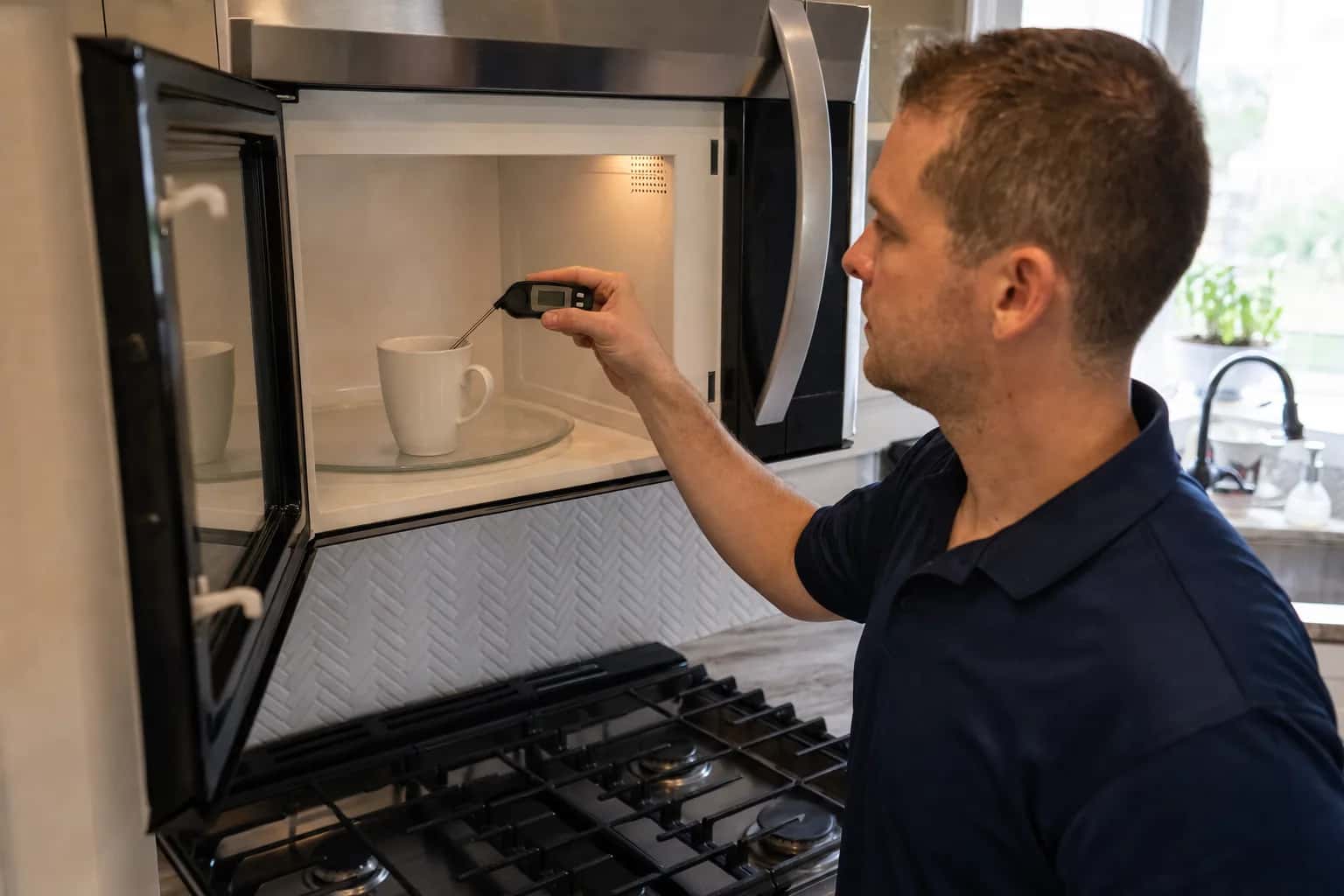
If your microwave is not heating but still lights up, hums and turns the plate, either a setting is keeping the heat off or a part in the high-voltage circuit that makes the heat has failed. The first takes a minute to fix yourself. The second needs a technician, and on an over-the-range or built-in microwave it is usually worth doing.
Safety first: the capacitor can shock you even unplugged
Never open the microwave's cabinet or remove its cover, for any reason. A microwave is not like other kitchen appliances inside. It steps household power up to thousands of volts to run the magnetron, and part of that circuit, the high-voltage capacitor, stores a charge.
GE Appliances warns that this internal high-voltage capacitor can hold a high-voltage charge even after the microwave has been unplugged, and for safety reasons it offers no do-it-yourself repair advice on microwaves at all.
The Consumer Product Safety Commission warns against do-it-yourself microwave repair. It counted an annual average of two electrocution deaths from 2006 through 2008 among consumers trying to repair microwave ovens, and notes that if certain internal devices fail, even an unplugged oven can cause serious injury.
Service manuals say the same thing to professionals. Sharp's service manual for its R-305DW microwave warns technicians that contact with the high-voltage capacitor, transformer, rectifier or magnetron may result in a severe, possibly fatal, electrical shock, and tells them to discharge the capacitor before servicing anything inside. Unplugging is not enough. Every check below is done from the outside.
The FDA, which regulates microwave ovens, adds one more rule: do not operate a microwave whose door does not close firmly or is bent, warped or otherwise damaged, and stop using one that keeps running with the door open.
Checks you can do yourself
- Check the settings. A low power level, a Delay Start still counting down, or a kitchen timer started instead of a cook cycle can all look like a microwave that runs without heating. KitchenAid lists a low power level and Delay Start among the common setting causes. Clear the display and set a cook time at 100% power. If the keypad does nothing, see microwave stopped working for the control lock.
- Rule out demo mode. Showroom demo mode runs the light, fan and turntable without heating. Samsung notes that in demo mode the timer counts down much faster than usual, and on its models with an Options or My Settings button, demo mode is option 6; setting it to 2 turns it off. Other brands use different steps, so check your owner's manual.
- Close the door firmly. Samsung says that if the door is not completely shut, the microwave may run but will not heat. Wipe crumbs off the door edge and frame with a damp cloth. If the door is bent or a latch is broken, stop using the microwave.
- Check the turntable. The glass tray should sit right side up on its roller ring and hub, with no food under the wheels, and any Turntable On/Off pad should be on.
- Do the water test. Heat one cup (250 mL) of water on full power for one minute; it should come out noticeably warmer. Never test the microwave empty. Lift the cup carefully, because water heated on its own can superheat and erupt; USDA suggests a container with sloping sides, such as a measuring cup, and leaving a microwave-safe spoon in it.
- Reset it. Unplug it, or switch off the breaker on an over-the-range model, for one minute, then repeat the water test.
If the water is still cold, the fault is inside the cabinet.
Microwave runs but stopped heating
The light, fan, display and turntable run on ordinary 120-volt power. Heating is a separate circuit. In the Sharp service manual's description of one model, a power transformer turns 120 volts into roughly 2,370 volts, which feeds a voltage doubler built from the high-voltage capacitor and rectifier (diode), which in turn powers the magnetron that makes the microwaves. If one of those parts fails, or a door switch stops confirming the door is shut, everything else keeps running and the food stays cold.
How to fix a microwave that is not heating
The safe fixes are the checks above. Beyond them, the repair is inside the high-voltage circuit. A technician unplugs the microwave, discharges the capacitor, and then tests the magnetron, diode, capacitor, transformer and door switches one at a time so only the failed part is replaced. GE notes that special equipment is generally needed to diagnose a microwave that runs but does not heat. On an over-the-range or built-in model, that is a job for microwave repair in Atlanta, and you get a written price before any work starts.
Microwave not heating evenly
Some unevenness is normal. USDA notes that microwaves can cook unevenly and leave cold spots where harmful bacteria survive, and recommends stirring or turning food midway even when there is a turntable. If the problem is new, check these:
- Turntable. A plate that has stopped turning leaves food in the same hot and cold spots. If it is seated and switched on but will not turn, the turntable motor has probably failed; see microwave not spinning.
- Power level. Large cuts of meat cook more evenly on medium (50%) power for longer, so heat reaches the center without overcooking the outside.
- Arrangement. Arrange food evenly in a covered dish, add a little liquid if needed, and stir or turn it halfway through. Reheat leftovers until steaming and check that they reach 165°F with a food thermometer.
- No turntable? Some microwaves, such as microwave drawers, have a flat floor and use a stirrer fan to spread the energy instead; Sharp's microwave drawer service manual describes a stir fan motor. New hot and cold patches in one of these can mean the stirrer has stopped.
Not heating as well as it used to
Magnetrons weaken with age, but rule out simple causes first. Plug the microwave straight into a wall outlet, not an extension cord, because a lower voltage makes a microwave cook slowly, as Panasonic explains.
On a generator or inverter, Whirlpool says there may be enough power for the lights and controls but not for heating. A countertop model also needs clearance on every side to vent, and without enough clearance it will either not heat or heat weakly.
Then try USDA's time-to-boil test: one cup of ice-cold water (ice removed) in a 2-cup glass measure, on High, watching for the boil. Under 2 minutes means 1,000 watts or more, about 2½ minutes means about 800 watts, about 3 minutes means 650 to 700 watts, and no boil by 4 minutes means a slow oven of 300 to 500 watts. If a 1,000-watt microwave (check inside the door or the manual) now takes 3 minutes or more, it is well short, and the magnetron is the usual suspect.
Sparking inside the microwave
Stop it the moment you see sparks. USDA says arcing caught at once should not damage the oven, and lists the usual causes:
- Metal. Gold paint on dishes, twist ties, foil and other metal, or a metal rack out of place. Some foods, such as raw carrots and hot dogs, can spark too.
- Food spills. Spills cause popping noises and can burn onto the walls. Once the microwave has cooled, unplug it and wipe the inside with a soft, damp cloth.
- A damaged cover on an inside wall. The small panel on one wall of the cavity covers the opening the microwaves come through. If it is burned, cracked or soaked with grease, stop using the microwave and have it checked.
If it still sparks, or the paint inside is peeling or holed, stop using it. GE Appliances says a hole in the cavity wall is not repairable.
What usually fails
- Magnetron. It makes the microwaves. A failed one means no heat and a weak one means slow heat. KitchenAid notes that magnetrons generally cannot be repaired, and that a failing one can also blow a fuse.
- High-voltage diode. It feeds power to the magnetron, so there is no heat when it fails.
- High-voltage capacitor. Part of the same circuit, and the reason the inside is dangerous even when unplugged.
- High-voltage transformer. It steps 120 volts up to thousands; no heat when it fails.
- Door interlock switches. A switch that does not confirm the door is shut can let the light and fan run with no heat. An interior light that does not come on when the door opens is one warning sign.
- Turntable motor or stirrer. Patchy heating.
- Control board. Occasionally the cause; we confirm it with tests first.
Thermal cutouts and the internal fuse usually leave a microwave dead or shutting itself off; see microwave stopped working.
What it costs in Atlanta
We repair over-the-range and built-in microwaves. The diagnostic is $80, or $120 for a microwave-oven combo, and it is waived when you approve the repair. Repairs start at $180 plus parts for over-the-range and built-in microwaves and $250 plus parts for oven-microwave combos, quoted as a flat rate in writing before any work begins. When the part is in stock, the repair can often be finished on the first visit, and if a part must be ordered there is no trip charge for the return. Every repair carries our 60-day parts-and-labor warranty. See our pricing.
Repair or replace?
A countertop microwave is usually cheaper to replace than to repair, and we do not service countertop models. Over-the-range and built-in microwaves cost more and have to be mounted or fitted to your cabinets, so repair usually wins. Replacing an over-the-range unit anyway? We can install the new one. Our repair-or-replace guide explains the 50% rule.
Schedule a visit or read about our microwave repair service. Prefer to talk? Call (470) 778-4087.
Sources
- GE Appliances: Microwave runs but does not heat
- CPSC: Electrocution Hazard with Do-It-Yourself Repairs of Microwave Ovens (PDF)
- Sharp: R-305DW microwave oven service manual (PDF)
- Samsung: Microwave has stopped working or will not heat
- KitchenAid: How to Troubleshoot a Non-Heating Microwave
- USDA FSIS: Cooking with Microwave Ovens
How we write and check these guides: editorial policy. Spot an error? Email hello@atlantaappliancetechs.com.
About Atlanta Appliance Techs
Atlanta Appliance Techs is a locally owned appliance repair company serving Metro Atlanta, including microwave repair in Atlanta. $80 diagnostic waived with the repair, 60-day parts-and-labor warranty, and gas, electric and induction appliances. More about us.