Pricing
Is It Worth Repairing a Microwave? Countertop vs Over-the-Range
Is it worth repairing a microwave? Why countertop models are usually cheaper to replace, when over-the-range and built-in units are worth fixing, and costs.
By Atlanta Appliance Techs · Published · Updated · 5 min read
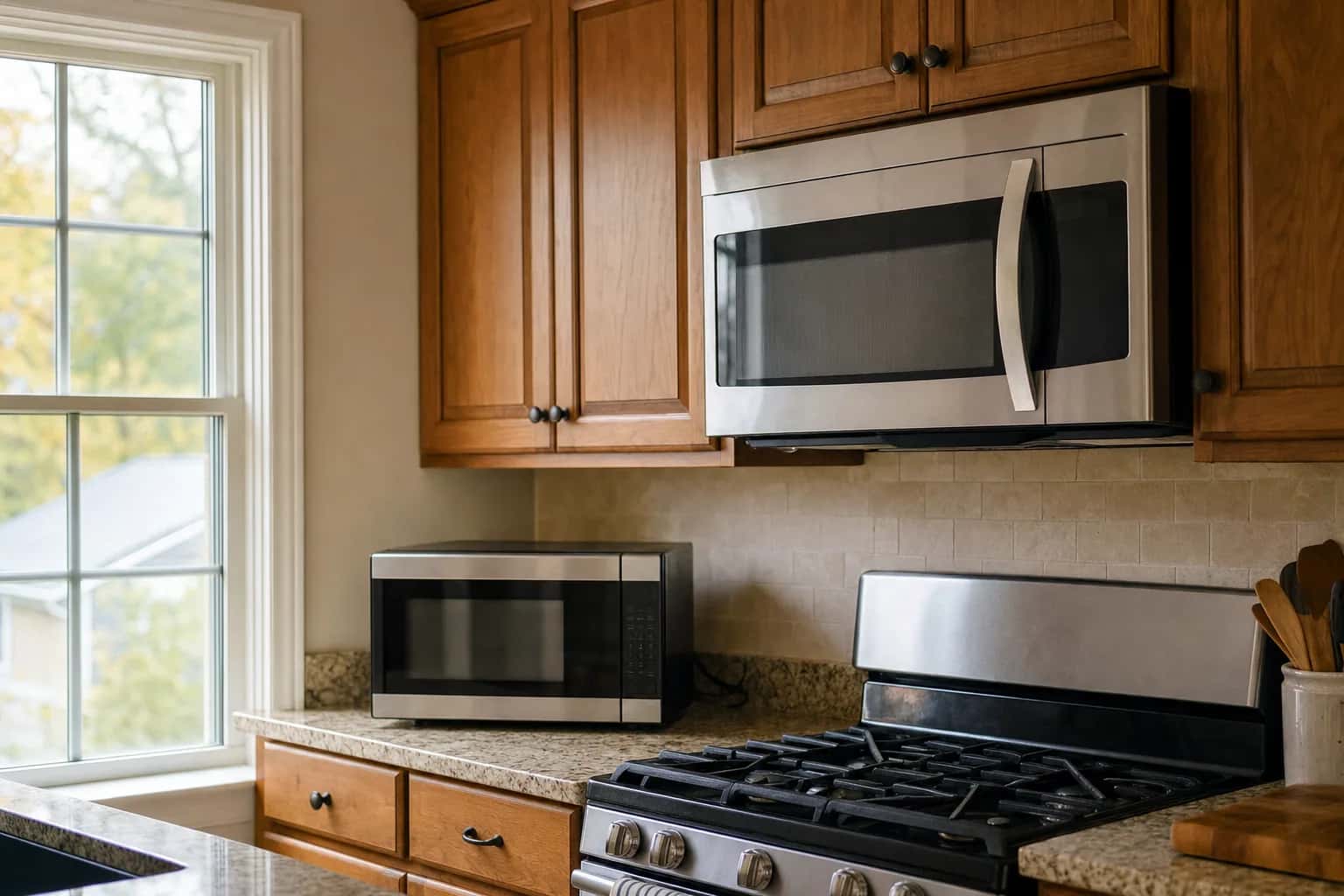
Is it worth repairing a microwave? For a countertop model, usually not; a new countertop microwave typically costs less than a professional repair, so replacing it is the sensible choice. For an over-the-range or built-in microwave, usually yes, because those units cost more and a replacement has to be mounted, vented or fitted into your cabinets.
Safety first: never open the cabinet
Never open a microwave's cabinet or remove its cover. The Consumer Product Safety Commission warns against do-it-yourself microwave repair and strongly recommends having professionals do it, because the possibility of electrical shock remains even after the oven is disconnected from power.
The reason is the high-voltage capacitor. GE Appliances explains that this internal capacitor can hold a high-voltage charge even after the microwave has been unplugged, and it offers no do-it-yourself repair advice on microwaves for that reason. Every check in this guide is done from the outside.
When is it worth repairing a microwave?
KitchenAid puts it plainly: the decision is a calculation between the cost of the appliance and the cost of the repair. Compact models cost far less than feature-rich ones, so a compact microwave may be worth replacing, while an advanced model, such as one with convection cooking, may be worth repairing.
We add the same 50% rule we use for every appliance: if the repair costs more than half the price of a comparable new unit, and the unit is past the middle of its life, replace it. Our repair-or-replace guide walks through the full decision. With microwaves, the answer depends mostly on the type you have.
Countertop microwaves: usually replace
We repair over-the-range and built-in microwaves; we do not repair countertop models. For most countertop microwaves the numbers favor replacement anyway: a professional repair means a service visit plus high-voltage parts, and that usually adds up to more than a new countertop unit. If yours has stopped heating or will not power on, try the outside checks below first. If they do not fix it, replacing it is usually the better value.
Over-the-range microwaves: usually worth repairing
An over-the-range microwave doubles as the vent hood and cooktop light, and replacing one is a real job: a mounting plate on the wall, bolts through the upper cabinet, a vent set up either to exhaust outdoors or to recirculate through a charcoal filter, and its own electrical connection. On a unit in good condition, repair usually wins, and our over-the-range microwave repair starts with an $80 diagnostic that is waived when you approve the work. If you decide to replace it anyway, we can install the new one.
Built-in microwaves and microwave-oven combos
A built-in microwave sits in a cabinet or wall opening, often with a trim kit, and a replacement has to fit that exact space. That makes repair the usual answer. The diagnostic is $80, and repairs start at $180 plus parts.
A microwave-oven combo puts a microwave and a wall oven in one built-in unit, so replacing it means replacing both. The diagnostic is $120, and repairs start at $250 plus parts. On a combo, repair is usually the better value.
Magnetron failure: is it worth fixing?
According to the FDA, the magnetron is the part inside the oven that produces the microwaves. When it fails, the microwave lights up, runs and turns the plate but does not heat, and a weak one heats slowly.
KitchenAid notes that magnetrons generally cannot be repaired, that a failing one can also blow a fuse, and that because of the electrical work involved, a professional should replace it. It is one of the more expensive microwave parts. On a countertop model, a failed magnetron is a clear sign to replace. On an over-the-range or built-in unit, replacing the magnetron is usually still better value than buying and installing a new microwave.
What usually fails
- Door interlock switches. The microwave will not start, or it stops the moment the door opens. KitchenAid notes that a light that does not come on when you open the door can be a sign the door switch is not working properly.
- Internal fuse. A completely dead microwave. A fuse blows for a reason, such as a failed door switch or a short, so it is replaced along with whatever blew it.
- High-voltage diode or capacitor. No heat. The diode feeds power to the magnetron, and the capacitor stores the high-voltage charge.
- Magnetron. No heat, or weak heat.
- Control board. A dead display or keypad, often after a power surge.
- Turntable motor. The plate stops turning and food heats unevenly.
Sharp's service manual for its R-305DW microwave lists every one of these parts, and warns service technicians that contact with the high-voltage capacitor, transformer, rectifier or magnetron may cause a severe, possibly fatal, electrical shock.
When a microwave is not worth fixing at any price
- A hole in the cavity wall. GE Appliances says a hole in the cavity wall is non-repairable and to stop using the microwave.
- Flaking or peeling interior coating. GE says to stop using a microwave whose coating is actively flaking or peeling and to replace it. Small surface chips do not affect performance.
- A damaged door. The FDA says not to operate a microwave whose door does not close firmly or is bent, warped or otherwise damaged, and to stop using one that keeps running with the door open. Have it checked before you use it again.
Checks before you call
- Check the breaker and any GFCI. Reset them, then switch the microwave's breaker off, or unplug it, for one minute and restore power.
- Look for a control lock, demo mode or a delay start. Each can make a working microwave look broken, and KitchenAid lists all three among the settings that can stop a microwave from heating. Your owner's manual shows how to clear them.
- Close the door firmly. A microwave will not start unless the door is fully latched.
- Do the water test. Whirlpool's test is one cup of water on full power for one minute; it should come out noticeably warmer. If it does not, the fault is inside the cabinet.
Our guides to a microwave not heating and a microwave that stopped working go further.
What microwave repair costs
For over-the-range and built-in microwaves, the diagnostic is $80; for a microwave-oven combo it is $120. Either way it is waived when you approve the repair. Repairs start at $180 plus parts, or $250 plus parts on combos. The total depends on the part, so you get a written flat-rate estimate before any work begins and can decide with the real number in hand. When the part is in stock, the repair can often be finished on the first visit, there is no trip charge for a return visit to install an ordered part, and every repair carries our 60-day parts-and-labor warranty. See our pricing.
Schedule a visit or read about our microwave repair service. Prefer to talk? Call (470) 778-4087.
Sources
- CPSC: Electrocution Hazard with Do-It-Yourself Repairs of Microwave Ovens (PDF)
- GE Appliances: Microwave runs but does not heat
- KitchenAid: How to Troubleshoot a Non-Heating Microwave
- FDA: Microwave Ovens
- GE Appliances: Repair needed due to arcing, chipping, peeling or scorching
- Sharp: R-305DW microwave oven service manual (PDF)
How we write and check these guides: editorial policy. Spot an error? Email hello@atlantaappliancetechs.com.
About Atlanta Appliance Techs
Atlanta Appliance Techs is a locally owned appliance repair company serving Metro Atlanta, including microwave repair in Atlanta. $80 diagnostic waived with the repair, 60-day parts-and-labor warranty, and gas, electric and induction appliances. More about us.