Error Codes
LG Refrigerator Error Codes: What They Mean and What to Do
LG refrigerator error codes FF, rF, CF, dH, IF, gF and CO in one table, how to exit O F F demo mode, LG's reset steps, and when to call a technician.
By Atlanta Appliance Techs · Published · Updated · 7 min read
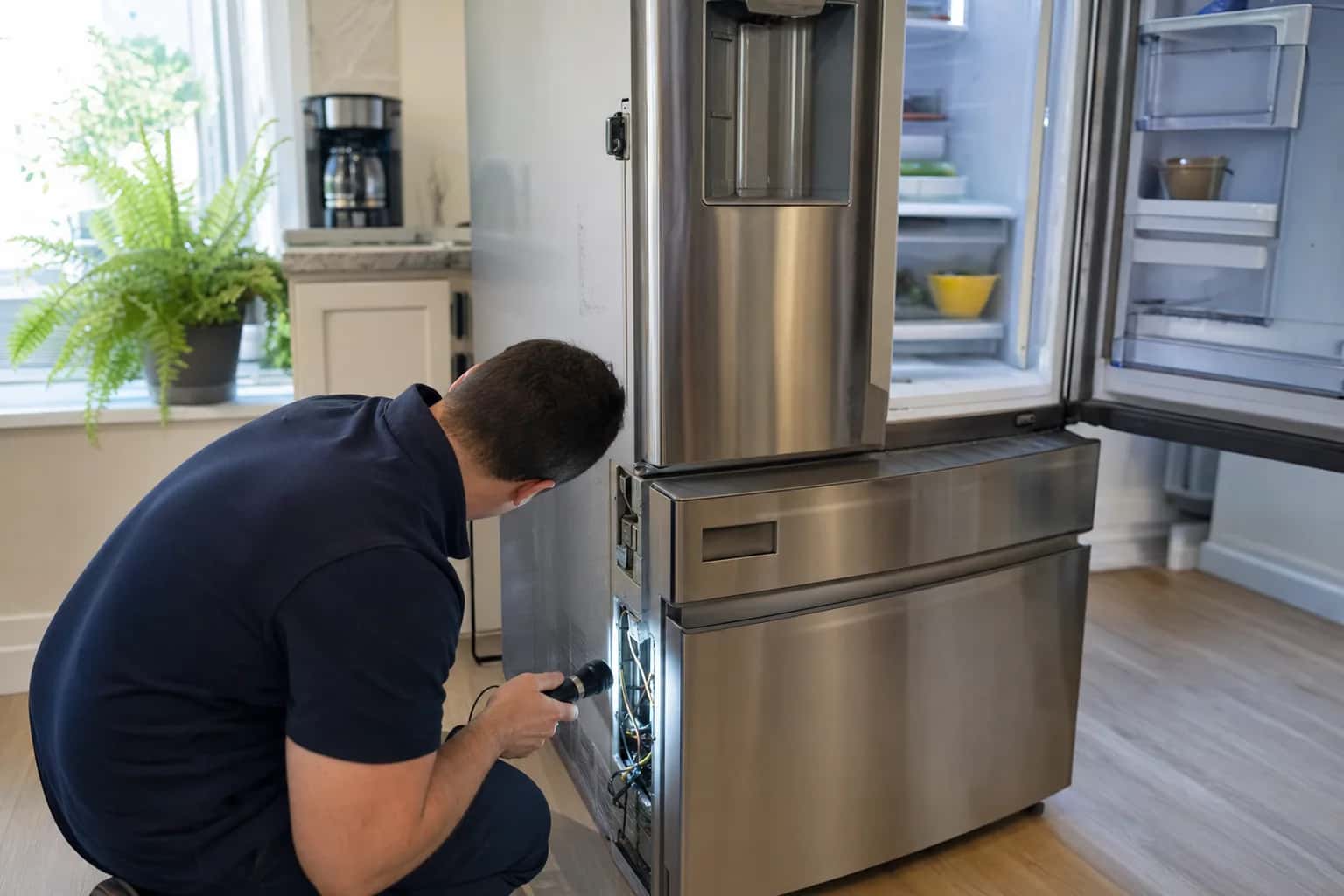
LG refrigerator error codes are the short letter codes on the control panel, such as FF, dH or IF, that point to the part the refrigerator thinks has a problem; O F F is not a fault at all but a store display mode. LG says codes can look different depending on the model and are often preceded by E, r or Er, so confirm your code in your owner's manual or on LG's refrigerator error code page.
| Code | Meaning | Try first | Call a technician when |
|---|---|---|---|
| O F F | Demo (display) mode: all cooling off | Exit demo mode (steps below) | Never; it is not a fault |
| FF | Freezer fan fault | Look for frost on the freezer's back wall; power reset | The code returns; LG lists it as a service code |
| rF | Refrigerator fan fault | Power reset | The code returns |
| CF | Condenser fan fault | Power reset; check nothing blocks the back grille | The code returns |
| IF | Ice maker fan fault | Power reset | The code returns |
| IS, It | Ice maker sensor or ice maker motor | Power reset | The code returns |
| gF | Water flow sensor | Open the water valve fully, straighten the hose, check pressure, reset | The supply checks out and gF returns |
| dH (FdH, dHF) | Defrost did not finish warming the coil in time | Look for ice on the freezer's back wall | Any time; LG lists it as a service code |
| FS, rS, r2, dS, rT, SS | Temperature sensor faults | Power reset | The code returns |
| FU | Freezer not getting cold enough | Reset, then check the setting, doors, vents and gaskets | It persists after LG's checks |
| CO, C1 | Communication error between boards | Power reset | The code returns |
| tt | Water tank missing, not seated or its sensor | Reseat the water tank | Seated correctly and tt returns |
| CH, CL | Refrigerant leak, high or low side | Nothing to try | Right away |
| Lo, HI | Room too cold or too hot | Change the room conditions | Not a fault |
Safety first: unplug the refrigerator or switch off its breaker before you pull it away from the wall or remove any panel. A manual defrost means water on the floor, so put towels down first.
How to reset an LG refrigerator
For most codes, a power reset is the first step:
- Record the code. Write it down or take a photo. If the display has gone back to normal, for example after a power failure, LG says you can bring the code back up by pressing the Freezer Temperature and Express Frz buttons at the same time for at least 3 seconds; your manual shows where they are on your panel.
- Unplug the refrigerator or switch off its breaker, and wait 60 seconds.
- Plug it straight into a wall outlet. LG says not to use a power strip or multiple socket.
- Give it time. A full restart can take up to 5 minutes while the refrigerator checks its components and starts the refrigerant flow.
- Watch for the code. If the same code comes back, the refrigerator needs service.
A reset clears the code; it does not fix a failed part. Our guide to resetting a refrigerator covers other brands too.
LG refrigerator demo mode: O F F on the display
LG says demo mode, also called display mode, disables all cooling in the refrigerator and freezer to save energy while the refrigerator is on a store floor, while the lights and panel keep working. If a new refrigerator lights up but never gets cold, check for this first. To turn it off:
- Open the refrigerator-side door.
- Press and hold the FRIDGE button and, while holding it, press Express FRZ three times.
- On some models, hold FRIDGE and Express FRZ together for 3 seconds instead.
A sound confirms that demo mode is off, and the temperature settings reappear. Button names vary by model, so check your manual if yours are labeled differently. No technician is needed.
LG refrigerator fan codes: FF, rF and CF
LG describes all three the same way: if a fan is blocked, the compressor overworks to hold the temperature, the inside warms and performance drops. The refrigerator has a sensor that detects a blocked fan.
FF (Er FF, E FF): freezer fan
This fan circulates cold air through the freezer. A common reason a freezer fan stops is ice: frost that builds up on the cooling coil can lock the blade. If you see heavy frost on the freezer's back wall, a full manual defrost may free it for now. LG's frost guide gives the procedure:
- Move the food to a cooler with ice. The USDA says a refrigerator without power keeps food safe for up to 4 hours with the doors closed, and yours will be open.
- Unplug the refrigerator, remove the ice and leave the doors open for at least 8 hours, with towels in and around it.
- Dry the inside, plug it back in and allow 24 to 48 hours for normal operation.
When to call a technician: FF comes back. A fan that keeps freezing means something else is wrong, most often the defrost system or a door that is not sealing.
rF (Er rF): refrigerator fan
This is the fan that circulates cold air in the fresh-food section. Reset the power; if rF returns, it needs service.
CF: condenser fan
This fan, at the back near the compressor, cools the condenser so the refrigerant can condense. With the refrigerator unplugged, make sure nothing is blocking the back grille or the fan area. If CF returns after a reset, it needs service.
LG refrigerator ice maker codes: IF, IS, It and gF
- IF: the ice maker fan, which circulates cold air from the freezer to the ice maker, has a fault, so ice making slows or stops.
- IS: a fault in the ice maker temperature sensor. The ice maker may stop dropping ice into the bucket.
- It: a fault with the ice maker motor.
- gF: a water flow sensor problem. LG says a closed water tap, a kinked hose or incorrect water pressure can cause it.
For gF, reset the power as above, then make sure the water supply valve is fully open, the hose is not kinked and your water pressure is within the range in your manual. If ice is the real complaint, see ice maker not making ice, and for slow water, see refrigerator water dispenser not working.
LG refrigerator defrost and sensor codes
dH (FdH, dHF): defrost failure
LG says dH means the temperature at the defrost sensor did not rise by more than 5°C (about 9°F) within 80 minutes of the start of a defrost, and that the evaporator may be blocked by ice. In plain terms, the defrost is not melting the frost, which points to the defrost heater, a fuse, the sensor or the control. A manual defrost can buy a few days, but the frost will return until the failed part is replaced.
FU: freezer cycle error
LG says FU appears when the freezer has not dropped below 3.5°C (about 38°F) within 10 minutes of starting, or has risen above that during operation. Its steps: reset the power, then check that the freezer is set to -18°C (0°F), that the door is not opened too often or too long, that food is not blocking the vents, and that the gaskets seal. LG's gasket test is a sheet of paper closed in the door; it should resist when you pull it.
Temperature sensor codes
LG lists these sensor codes as needing service, and says most of them reduce the refrigerator's performance:
- FS: freezer temperature sensor
- rS and r2: refrigerator temperature sensors, upper (R1) and lower (R2)
- dS: defrost sensor; LG notes the evaporator may ice up as a result
- rT: ambient (room) temperature sensor
- SS: water tank temperature sensor
Communication, refrigerant and room temperature codes
- CO: the main board and the display cannot communicate.
- C1: the dispenser and the display cannot communicate.
- tt: the water tank is missing, not inserted correctly, or its sensor has failed.
- CH and CL: LG says these indicate a refrigerant leak on the high-pressure or low side, which can be caused by a faulty valve. That is sealed-system work.
- Lo and HI: warnings that the room has dropped below -10°C (14°F) or risen above 50°C (122°F). They are not faults, but the refrigerator will not work well in those conditions.
For CH and CL, the repair means opening the sealed system, and under EPA rules technicians who service equipment that could release refrigerant must hold Section 608 certification.
What usually fails
- Fan motors. Behind FF, rF, CF and IF.
- Defrost parts. The heater, thermal fuse, sensor or a clogged drain, behind dH and repeat FF codes.
- Temperature sensors. Behind FS, rS, dS and the rest.
- Water valve or flow sensor. Behind gF and a quiet ice maker.
- Control board or wiring. Behind CO and C1.
- Sealed system. Behind CH and CL, and the most expensive repair on any refrigerator.
For a code that keeps coming back, LG refrigerator repair in Atlanta starts with testing the part the code points to, not swapping boards.
What it costs in Atlanta
The diagnostic is $80, waived when you approve the repair. Repairs start at $180 plus parts, with a written flat-rate estimate before any work begins. On standard brands, a typical refrigerator repair runs $250 to $500 all in; fans, defrost parts, relays and valves sit at the low end, and control boards and ice makers at the high end. See the typical totals on our pricing page. Sealed-system work is rarely worth it on an older refrigerator, and our repair-or-replace guide walks through that decision.
If a part has to be ordered for your LG refrigerator, there is no trip charge to come back and install it. Every repair carries our 60-day parts-and-labor warranty.
Schedule a visit or read about our refrigerator repair service. Prefer to talk? Call (470) 778-4087.
Sources
- LG: Digital and Analog Error Codes
- LG: Refrigerator Frost Buildup
- USDA FSIS: Keep Your Food Safe During Emergencies
- EPA: Section 608 Technician Certification
How we write and check these guides: editorial policy. Spot an error? Email hello@atlantaappliancetechs.com.
About Atlanta Appliance Techs
Atlanta Appliance Techs is a locally owned appliance repair company serving Metro Atlanta, including refrigerator repair in Atlanta. $80 diagnostic waived with the repair, 60-day parts-and-labor warranty, and gas, electric and induction appliances. More about us.