Dryers
Dryer Not Heating but Still Running? 6 Common Causes (and What You Can Check Yourself)
Electric dryer running but not heating? Six common causes, from a half-tripped breaker to a blown thermal fuse, what you can safely check, and repair costs.
By Atlanta Appliance Techs · Published · Updated · 9 min read
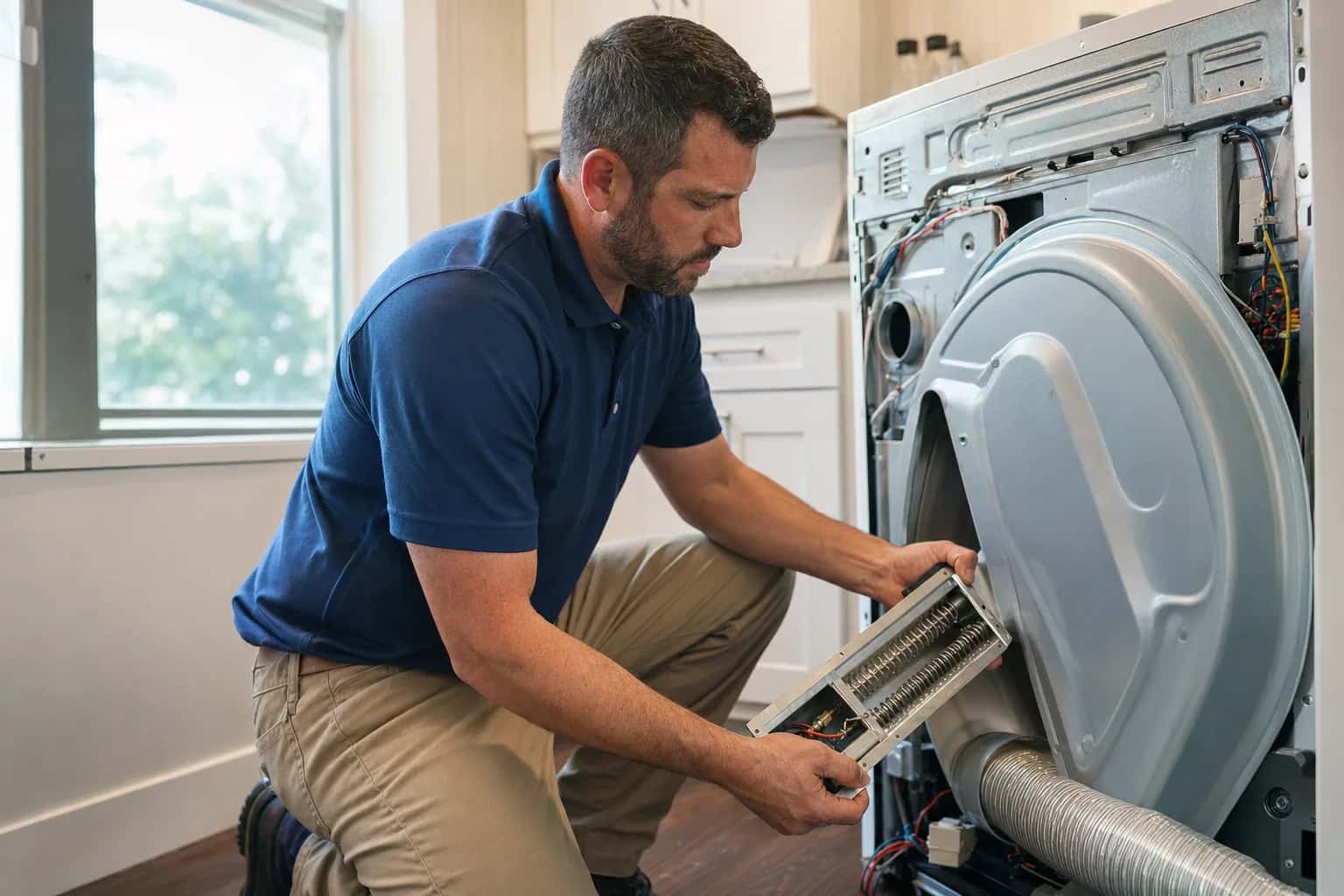
An electric dryer that tumbles but stays cold usually has one of six problems: a cycle that adds no heat, a power supply that has lost half of its 240 volts, a blown thermal fuse, a restricted vent that keeps tripping the safety devices, a failed heating element, or a failed thermostat or control. You can check the first two yourself in a few minutes. The rest need a technician with a meter, and most of them are inexpensive parts.
Safety first. An electric dryer runs on 240 volts. Unplug it or switch off its breaker before you pull it out or look behind it, and do not open panels or test the outlet yourself. If the cord, plug or outlet looks scorched or melted, leave the breaker off and call.
The six causes below are for electric dryers; gas dryers are covered further down. We repair both. If you ever smell gas, leave the house now and call 911 or your gas utility from outside, and do not touch light switches on the way out.
Quick answer
| Symptom | Likely cause | Safe to check yourself? | Typical fix |
|---|---|---|---|
| No heat on one cycle, heat on others | An air-only, fluff or cool-down setting | Yes: pick a heated timed cycle | No repair needed |
| Drum turns, no heat at all, started suddenly | Lost one leg of the 240-volt supply | Yes: switch the breaker fully off, then on | Breaker reset, or an electrician if it trips again |
| Dryer dead, or running cold, after it ran hot | Blown thermal fuse | No | Replace the fuse and clear the vent |
| Slow drying and a hot cabinet for weeks, then no heat | Restricted vent tripping a safety device | Partly: lint screen, duct behind the dryer, outside flap | Vent cleaning plus the tripped part |
| Cold air every cycle with power and fuse fine | Failed heating element | No | Replace the element |
| Weak heat, or heat that never comes on | Thermostat, thermal cutoff or control | No | Replace the failed part |
1. A cycle or setting that adds no heat
Start with the easy one. Whirlpool notes that its Air Only and Air/Fluff cycles add no heat at any point in the cycle. Cool-down, wrinkle-prevent and energy-saving settings run cooler or longer on purpose, too. Make sure the knob or display is on a heated dry cycle.
To test for heat, run the empty dryer on a heated timed cycle for five minutes, then open the door and feel inside. If it is warm, the heat source works and your problem is drying performance, which is covered in dryer takes forever to dry. If it is cold, keep going.
2. The dryer lost half of its 240-volt supply
This is the one you can check yourself, and a common reason for heat that stops suddenly. Your panel feeds an electric dryer two 120-volt legs that together make 240 volts. The motor and the controls run on 120 volts from one leg, while the heating element needs the full 240 volts across both. Lose one leg and, depending on which one, the dryer is either completely dead or the drum keeps turning while the heater gets nothing. GE puts it plainly: an electric dryer may run on a partial 120 volts but will not heat without its 208- or 240-volt supply.
A dryer can lose one leg in a few ways:
- A double-pole breaker that has tripped or is failing inside. A breaker can be partially tripped even when the handle looks normal, and a worn breaker can fail on one side only.
- A loose or burned connection at the outlet, in the cord, or at the terminal block where the cord enters the back of the dryer.
- A problem upstream of your panel, such as a failing utility service connection. If other 240-volt equipment like the water heater or air conditioner quits at the same time, or half the circuits in the house act strangely, call your electric utility or an electrician.
Samsung describes the same failure: an electric dryer has two circuits, they usually trip together, and when only one trips, the dryer turns on and spins but does not heat.
What to do:
- Find the dryer breaker in your panel. It is a double-width breaker with two switches joined by one handle, usually 30 amps.
- Push the handle firmly all the way to OFF. A tripped breaker can rest in the middle, and it will not reset until it goes fully off.
- Push it back to ON and run a heated timed cycle.
- If your home has a fuse box instead, an electric dryer uses two fuses, and both must be good.
If the heat comes back, you are done. If it does not, or if the breaker trips again, stop resetting it and call an electrician or a technician. GE lists a shorted heater, loose wires and failed components among the reasons a dryer trips a breaker, and says a breaker that trips right away usually points to the house wiring or the panel. Do not test the outlet with a meter or open the panel yourself.
3. A blown thermal fuse
The thermal fuse is a one-time safety device that opens when the dryer overheats. It cannot be reset; it has to be replaced. What you notice when it blows depends on how your dryer is wired.
On Whirlpool-built dryers and many GE models, a blown fuse shuts the dryer down, so the symptom is a dryer that will not start rather than one that runs cold. Whirlpool describes the fuse as a one-time device that goes off when temperatures get too high, shutting down the dryer, and says it must be replaced before the dryer can be used again.
GE Appliances Factory Service lists the thermal fuse among the reasons a dryer will not start, and adds that a fuse probably blew because a blocked exhaust vent kept the dryer from releasing heat.
On some other designs, depending on the model, the fuse sits in the heater circuit, and the drum keeps turning with no heat. Either way, the fuse is not the real problem. It is the alarm. Replace it without clearing the vent and it blows again.
4. A restricted vent tripping the safety devices
A clogged vent does not usually stop the heater by itself. Whirlpool points out that a dirty lint screen or a blocked vent is more often the reason a dryer is slow to dry than the reason it will not heat. But a dryer that cannot push its hot, wet air outside runs hot, and that heat is what trips the high-limit thermostat and blows the thermal fuse.
The CPSC warns that lint can block airflow, cause excessive heat build-up and result in a fire in some dryers.
Checks you can do:
- Clean the lint screen before every load.
- With the dryer unplugged, pull it out and look at the duct behind it. Replace crushed foil or plastic duct with rigid or semi-rigid metal duct, the material most manufacturers specify.
- While the dryer runs, go outside and make sure air is actually coming out of the vent. If the vent exits through the roof, do not climb up to check; leave that to a professional.
Every dryer repair includes an airflow check at the machine. We do not clean duct runs, so if the duct itself is restricted, we will tell you and recommend a dryer vent cleaning professional for the full run.
5. A failed heating element
The element is a coil of resistance wire inside a metal housing. Over time the coil can break or short, and overheating from a restricted vent speeds that up. When it breaks, the dryer runs normally with cold air on every cycle, even though power and the fuse are fine.
Whirlpool recommends calling a professional, because the dryer has to be taken apart to examine or replace the element. If a meter confirms a broken coil, you need a technician to replace the heating element and check the thermostats and fuse at the same time, so the new element is not the only thing fixed.
6. A failed thermostat, thermal cutoff or control
Most electric dryers have a cycling thermostat, which switches the heater on and off to hold the drum temperature, and a high-limit thermostat, which cuts the heat if the dryer gets too hot. Some also have a thermal cutoff on the heater housing. If any of these fails open, the heater never comes on. If the cycling thermostat opens too early, the dryer runs warm but never hot.
On electronic models, the control board switches the heater through a relay and reads a temperature sensor (thermistor). A failed relay or sensor can also leave the dryer cold. None of these parts looks broken to the eye, so a technician tests each one with a meter before replacing anything.
Gas dryer not heating
A gas dryer plugs into an ordinary outlet and burns gas for heat, so the 240-volt checks above do not apply, but the vent, the thermal fuse, the thermostats and the control do. Start with the two checks Whirlpool lists: the drum of a gas dryer will turn but the dryer will not heat if the gas shutoff valve is closed, and the valve is open when its handle is parallel to the gas pipe; then make sure the household breaker has not tripped. Run the five-minute empty heat test again.
If the shutoff is open and the dryer still runs cold, the problem is in the burner. GE describes how the system works on its gas dryers: a glow-bar igniter heats up about 15 seconds after the dryer starts, a sensor then signals the gas valve to open, the igniter lights the gas and cycles off, and the sequence repeats each time the dryer calls for heat. Gas is not released unless the igniter is working. So an igniter that never glows, a flame sensor that never signals the valve, or gas valve coils that will not open the valve all leave the dryer cold. Coils often weaken as they warm up, which is why a gas dryer that heats at first and goes cold mid-cycle is a common complaint.
These are technician repairs: the burner sits behind the front panel, and testing means meters on a gas appliance in operation. Do not try to light the burner yourself. The gas piping and the shutoff valve are work for a licensed plumber or gas contractor; we repair the dryer. If you smell gas, leave the house and call 911 or your gas utility from outside; Atlanta Gas Light's 24-hour emergency line is 877-427-4321.
What to check first: a decision flow
- Is it on a heated cycle? If not, select one and do the five-minute empty test.
- Does the dryer start at all? If it is dead, see dryer not spinning or starting. On many models a blown thermal fuse or a lost power leg causes that.
- Did the heat stop suddenly? Switch the double-pole breaker fully off, then on, and test again.
- Did the breaker trip again, or is there still no heat? Stop there. Call an electrician for the breaker, wiring or outlet, or a technician for the dryer.
- Has drying been getting slower for weeks? Clean the lint screen, check the duct behind the dryer and the outside vent, and plan for a vent cleaning before or along with any repair.
- Everything above checks out? The element, a thermostat, the thermal fuse or the control has failed. Book a diagnostic.
What dryer repair costs
The diagnostic is $80, and it is waived when you approve the repair. Dryer repairs start at $180 labor plus parts, and typical dryer repairs on standard brands run $230 to $380 all in, parts and labor; see typical totals on our pricing page. You get a written flat-rate price before any work begins, and every repair carries our 60-day parts-and-labor warranty.
Schedule a visit or read about our dryer repair service. Prefer to talk? Call (470) 778-4087.
Sources
- Whirlpool: Dryer is Not Heating
- Whirlpool: Dryer not heating troubleshooting guide
- GE Appliances: Electric Dryer - Runs But Does Not Heat
- GE Appliances Factory Service: Why won't my dryer start?
- Samsung: Clothes are not dry after using Samsung dryer
- CPSC: Overheated Clothes Dryers Can Cause Fires (Safety Alert)
- Whirlpool: Not Heating, Gas Dryer
- GE Appliances: Gas Dryer, Ignition Systems
How we write and check these guides: editorial policy. Spot an error? Email hello@atlantaappliancetechs.com.
About Atlanta Appliance Techs
Atlanta Appliance Techs is a locally owned appliance repair company serving Metro Atlanta, including dryer repair in Atlanta. $80 diagnostic waived with the repair, 60-day parts-and-labor warranty, and gas, electric and induction appliances. More about us.