Dishwashers
Dishwasher Won't Start or Turn On? What to Check
Dishwasher won't start, won't turn on or won't latch? The simple checks to try first, why it may not fill with water, what usually fails, and repair costs.
By Atlanta Appliance Techs · Published · Updated · 7 min read
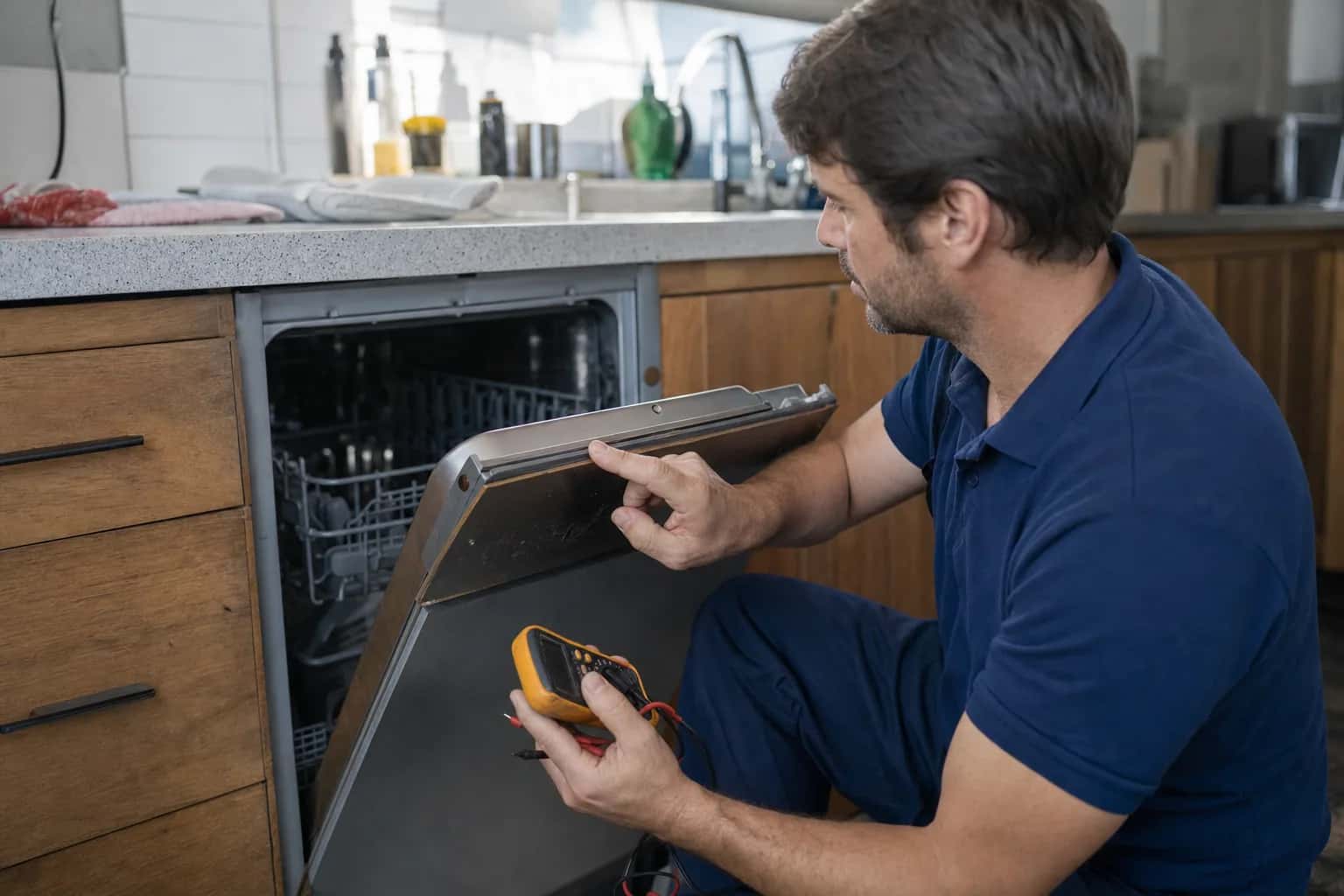
If your dishwasher won't start, it is often not broken at all. Before anything else, look for a control lock, a delay-start countdown and a door that is not fully latched; any one of them will stop a perfectly good dishwasher. If the control panel is completely dark, work back to the power: the breaker, a GFCI outlet or a wall switch. If none of that helps, the usual failures are a door latch, a thermal fuse or the control board, and all of them are standard repairs.
A word on safety
A dishwasher puts water and 120-volt power in a tight space. Switch it off at the breaker before you pull it out, take off the lower kick panel or reach under the door. If there is water on the floor around it, switch off the breaker before you touch the dishwasher. Never tape, jam or bypass the door latch to make it run; the latch is what keeps a running dishwasher from spraying hot water into your kitchen.
Dishwasher won't start? Checks you can do yourself
- Look for a lock icon. GE says most dishwasher models with electronic controls have a child lock-out feature that keeps the buttons from starting a cycle. On a Whirlpool, a lit lock icon on the display means the control lock is on. Your owner's manual shows how to unlock it, often by holding one button for a few seconds.
- Look for a countdown. If someone pressed Delay Start, the dishwasher will not run until the delay time is reached; GE notes that the display may show the hours remaining, such as 2H. Cancel it (on Whirlpool models, with the Cancel/Drain button) and start again.
- Close the door firmly. GE says the door latch must be fully engaged for the switch to signal that the door is closed properly. Push the door shut until it clicks, and make sure nothing blocks it; even a lower rack installed backward can keep the door from latching.
- Press Start, then shut the door promptly. On some models you press Start with the door open and then have only a few seconds to close it. Whirlpool's instruction for its models is to close the door within 3 seconds; if the door is not latched, the Start/Resume light flashes and the cycle does not proceed. Your manual explains how yours starts.
- Check the power. Reset the breaker; for a hard-wired dishwasher, Whirlpool notes that resetting a tripped breaker might solve the problem. If the dishwasher plugs into an outlet under the sink, press Reset on any GFCI outlet that has tripped, including one up at the counter. Some dishwashers are wired to a wall switch, and it is easy to flip the wrong one when it sits next to the disposal switch.
- Make sure the water is on. Whirlpool says that if the dishwasher does not detect water, the cycle won't start. The supply valve under the sink should be fully open, especially after plumbing work.
- Reset the control. Press Cancel, then unplug the dishwasher or switch off its breaker for about 1 minute. Restore power, close the door firmly, choose a cycle and press Start. This is the reset Whirlpool describes, and it is safe to try on any dishwasher. Other brands' steps are in how to reset a dishwasher.
Dishwasher won't turn on at all
If nothing lights up when you press a button, power is not getting through. Once you have ruled out the breaker, GFCI and wall switch, the usual causes are:
- Thermal fuse. Many dishwashers have a one-time safety fuse that cuts power when it senses overheating. When it blows, the dishwasher goes completely dead, and the technician should also find out why it blew.
- Control board. Power surges and lightning are hard on electronics. If the dishwasher died after a storm, the control board is a strong suspect, so try the one-minute reset first.
- Wiring. A loose connection in the junction box behind the kick panel. Leave that to a technician.
Lights come on but it won't start
A lit panel that ignores the Start button points back to the checks above: control lock, delay start, the door latch and the water supply. GE also lists Demo Mode and Sleep or Sabbath Mode on some models, and on some models with an LCD display, a Leak Protection feature that can stop operation; your manual shows how to clear them. If the lights are flashing in a pattern or a code appears, write it down before you reset anything, because it tells the technician where to look; Whirlpool owners can decode it with our Whirlpool dishwasher error codes chart. If the buttons respond unevenly, or some do nothing at all, the touchpad or user interface board may have failed.
If you hear a hum but the dishwasher does not run, GE suggests, for several of its model families, pouring hot water into the bottom of the tub and pressing Start again. A hum that keeps coming back points to the pump.
Dishwasher won't latch
If the door will not stay shut or click closed:
- Check what is in the way. A rack pushed in crooked or installed backward, a tall pan, or a utensil hanging through the rack.
- Check the latch itself. A cracked latch or a broken strike cannot hold the door, and a latch whose switch has worn out can close normally while the control still thinks the door is open.
- Check the fit. If the dishwasher has come loose from its mounting brackets under the counter, it can shift so the door no longer lines up with the latch.
A worn latch or door switch is usually a straightforward repair, and it is the kind of job door latch and control board repair covers.
Dishwasher not filling with water
If the dishwasher starts and you hear it running, but no water comes in:
- The supply valve. Whirlpool says the water supply valve must be completely open for the dishwasher to fill, and it may have been closed during plumbing work.
- The float. A small float in the tub floor shuts off the fill if the water rises too high. GE says a malfunctioning flood float can prevent water from entering; on its models from 2015 onward owners can check it, and older models need service. With the power off, make sure it moves up and down freely.
- The inlet valve. An electric valve behind the kick panel lets water in. If it has failed, or its screen is clogged with sediment, little or no water gets through.
- The door latch. If the control does not see a latched door, the cycle will not proceed.
- A drain problem. GE notes that a dishwasher that is not draining properly may not let new water in. If there is standing water in the tub, start with our dishwasher not draining checklist.
- A short delay is normal. GE says a new installation may wait up to 3 minutes after you press Start before the water valve turns on.
Low household water pressure can also slow the fill; Whirlpool calls for 20 to 120 psi.
What usually fails
- Door latch or door switch. The door will not latch, or it latches but the dishwasher acts as if it is open.
- Thermal fuse. Completely dead, with a working breaker and outlet.
- Control board. Dead or erratic, often after a power surge.
- User interface or touchpad. Lights on, but the buttons do not respond.
- Water inlet valve. Starts but will not fill.
- Float switch. Starts but will not fill, because the dishwasher thinks the tub is already full.
What it costs in Atlanta
The diagnostic visit is $80, waived when you approve the repair. Dishwasher repairs start at $180 plus parts, and you get a written flat-rate estimate before any work begins. On standard brands, typical dishwasher repairs run about $250 to $430 all in; latches, switches, fuses and inlet valves are at the lower end, and control boards cost more. See typical total costs. The repair is done on the first visit when the part is in stock, and if a part has to be ordered, there is no trip charge for the return visit. Every repair carries our 60-day parts-and-labor warranty.
Repair or replace?
A latch, fuse, valve or even a control board is usually worth pricing out before you replace a dishwasher. As a rough estimate, InterNACHI's life-expectancy chart puts a dishwasher at about 9 years. If the tub is cracked or the machine is near the end of its life, our repair-or-replace guide helps you decide. If yours runs but leaves the dishes dirty, see dishwasher not cleaning dishes.
Schedule a visit or read about our dishwasher repair service. Prefer to talk? Call (470) 778-4087.
Sources
- Whirlpool: Dishwasher not starting or not operating
- Whirlpool: Will not fill with water (dishwasher)
- GE Appliances: My dishwasher will not run or does not start
- GE Appliances: My dishwasher does not fill with water
- Whirlpool: Dishes are not clean (water supply and pressure)
How we write and check these guides: editorial policy. Spot an error? Email hello@atlantaappliancetechs.com.
About Atlanta Appliance Techs
Atlanta Appliance Techs is a locally owned appliance repair company serving Metro Atlanta, including dishwasher repair in Atlanta. $80 diagnostic waived with the repair, 60-day parts-and-labor warranty, and gas, electric and induction appliances. More about us.