Dishwashers
Dishwasher Not Draining? A 10-Minute Checklist Before You Call
Dishwasher not draining? Seven checks in order, from the disposal and knockout plug to the filter, air gap and drain hose, plus what the drain codes mean.
By Atlanta Appliance Techs · Published · Updated · 8 min read
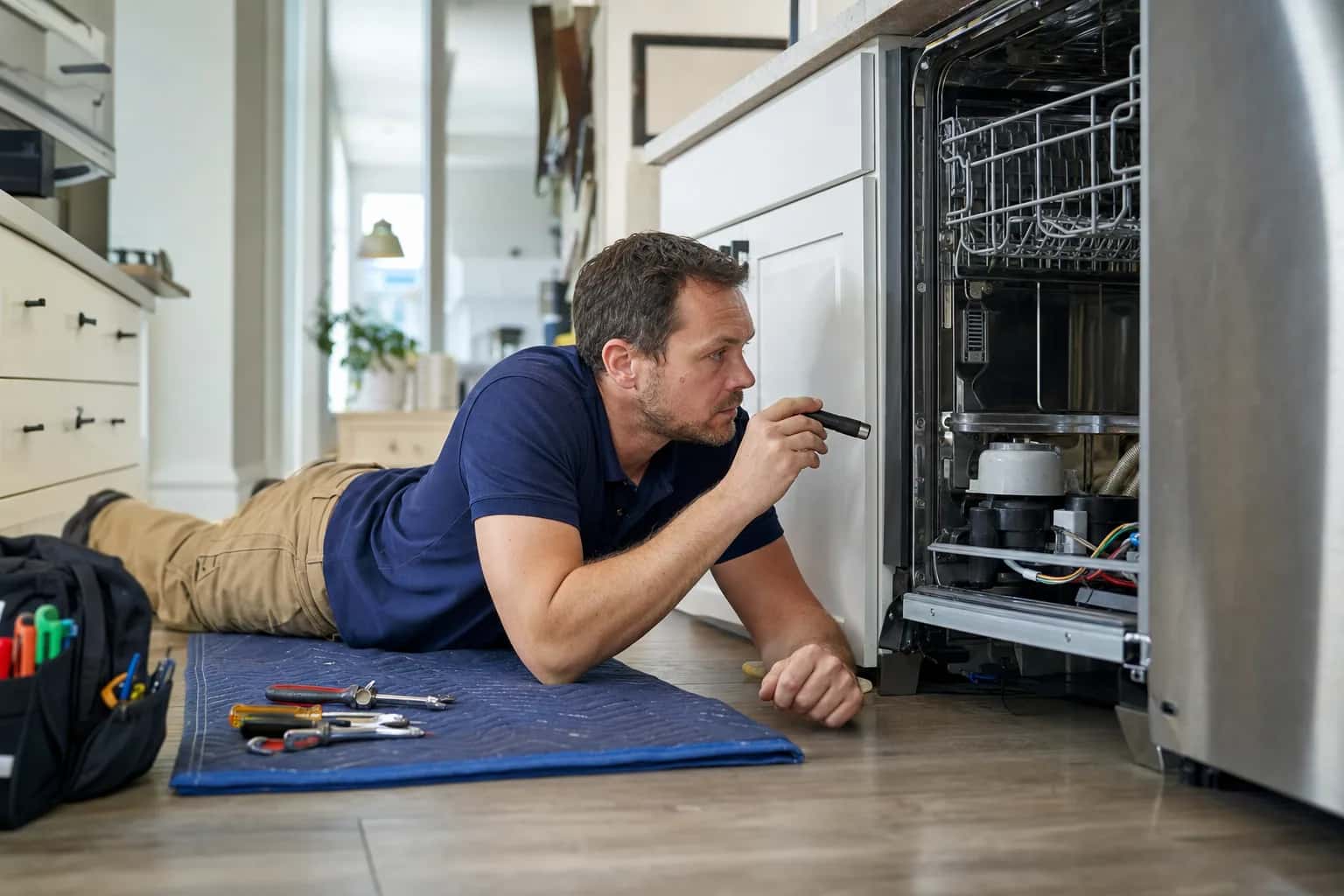
A dishwasher with water standing in the bottom is often a clog you can clear yourself in about ten minutes: a full garbage disposal, a knockout plug that was never removed, a dirty filter, a clogged air gap or a kinked drain hose. Work through the checks below in order. If the water still will not drain, or the dishwasher hums during the drain without moving any water, the drain pump is the likely problem, and that is the point to call a technician.
Quick answer
| Symptom | Likely cause | Safe to check yourself? | Typical fix |
|---|---|---|---|
| Water in the tub, and the sink drains slowly too | Clogged disposal or sink drain | Yes | Run the disposal; clear the sink drain |
| Never drained properly since a new disposal went in | Knockout plug still in the disposal's dishwasher inlet | Yes, if you are comfortable taking off the drain hose | Remove the plug |
| Dirty water with food bits in the bottom | Clogged filter or sump | Yes | Clean the filter and the sump |
| Water backing up at the air gap by the faucet | Clogged air gap or drain line | Yes | Take off the cap and clear the debris |
| Slow or no draining, nothing else wrong | Kinked or clogged drain hose | Yes, under the sink | Straighten or clear the hose |
| Suds in the tub | Wrong detergent, or too much of it | Yes | Use only dishwasher detergent; clear the suds |
| Pump hums, water does not move | Jammed impeller or blocked pump | Partly: some brands let you clear the pump | Clear the pump, or replace it |
| No sound at all during the drain | Failed pump, or no power reaching it | No | Technician |
A little water can be normal
Not every puddle is a problem. GE says that on some of its models with only a Fine filter, 1 to 2 cups of clean water covering the bottom of the tub is normal. More water than that, or dirty water with food in it, means something is blocking the drain.
To make the checks easier, get the water out first. Whirlpool suggests bailing it into a bucket with a cup, then using a turkey baster or a hand pump for the water left in the sump.
1. Run the garbage disposal
Whirlpool notes that built-in dishwashers typically drain through the garbage disposal. If the disposal is full of food, the dishwasher cannot push water past it. Run the disposal with cold water for 30 seconds, then start a drain on the dishwasher (Cancel/Drain on many models).
GE also says to make sure the kitchen sink drain itself is not clogged, and to run the disposal before you start the dishwasher.
If the sink is slow to drain even with the dishwasher off, the clog is in the house plumbing, not the dishwasher, and a plumber is the right call.
2. Check for a knockout plug
If the dishwasher has not drained properly since a new disposal was installed, the plug inside the disposal's dishwasher inlet may still be there. InSinkErator describes the knockout plug as a small piece inside the disposal at the dishwasher inlet that has to be removed before the dishwasher drain hose is hooked up.
It is easy to miss: Whirlpool calls a forgotten knockout plug a common misdiagnosis for a clogged dishwasher. The drain hose has to come off the disposal to get the plug out, and the disposal's installation instructions show how. If you would rather not take plumbing apart, it is a short job for a technician or a plumber.
3. Clean the filter and the sump
Most modern dishwashers have a filter in the floor of the tub. On many Whirlpool models you twist the upper filter counterclockwise and lift it out; GE models have Fine and Ultra Fine filters. Rinse them under warm water.
Then look into the sump underneath. Whirlpool lists what turns up there: food particles, labels, seeds, toothpicks and glass. Also check that no paper or large object is covering the sump at the back of the tub, and clear out noodles, lettuce and bones. Wear gloves, because broken glass is sharp.
On a Bosch, the drain pump cover sits under the filter. For a blocked pump (code E25), Bosch's steps are to remove the filter, pry the cover up with a spoon until it clicks, pull it upward and then forward, remove debris (some of it may be sharp) and standing water with a sponge, and put the cover back firmly.
Put the filter back and lock it in place before the next cycle. Whirlpool recommends cleaning it about every 30 days.
4. Clear the air gap
If there is a small capped cylinder on the sink next to the faucet, that is an air gap. GE says to remove the cap and clean out any build-up of debris.
If water leaks out of the air gap and there are no suds in the tub, GE's leak guide points to a plumbing problem rather than the dishwasher.
5. Inspect the drain hose
Look under the sink, and with the breaker still off, behind the lower panel of the dishwasher if you can see the hose there. GE says to check the drain hose where it connects below the sink for a blockage or a kink.
Look for pinching, crushing and sharp bends behind the dishwasher too, and make sure the hose is securely clamped to the sink drain or disposal inlet.
The hose also has to be routed correctly. Whirlpool says it must have a high loop secured to the underside of the counter, or connect through an air gap, as local codes require. A hose that sits low can let dirty water flow back into the tub, and the connection to the waste tee or disposal inlet should sit above the drain trap and at least 20 inches above the floor.
If a hose has to be replaced, GE recommends a new corrugated hose rather than reusing the old one.
6. Rule out suds
GE says the wrong type of detergent, or too much of it, can cause oversudsing that keeps the dishwasher from draining properly. Hand dish liquid in the dispenser is a typical culprit.
If the tub is full of foam, Whirlpool's fix for its suds code is to scoop out the suds, add 2 to 3 tablespoons of vegetable oil, and run a full cycle with no detergent and no dishes. After that, use only detergent made for automatic dishwashers. Suds can also push water out under the door; see dishwasher leaking from the bottom.
7. Read the error code
Many dishwashers tell you when they cannot drain. These are the drain codes the manufacturers publish:
| Brand | Code | What the manufacturer says it means |
|---|---|---|
| Whirlpool, Maytag, KitchenAid | F9E1 | Long drain: the dishwasher is not draining |
| Whirlpool | F9E2 | Drain motor error |
| Bosch | E24 (or E6103) | Not draining properly because the drain filter is blocked |
| Bosch | E25 (or E6102) | Drain pump blocked, or pump cover loose or missing |
| Bosch | E22 (or E9240) | Filter blocked |
| GE | C1 | Pump-out during drain has exceeded 2 minutes |
| GE | C2 | Total pump-out cycle exceeds 7 minutes |
| GE | C3 | The dishwasher will not drain |
| GE | FTD or F56 | Failure to drain |
Whirlpool's F8E4 is different: it means water in the drip tray, which is a leak. Codes vary by model, so confirm yours in the owner's manual. Our guides to Whirlpool dishwasher error codes and Bosch dishwasher error codes walk through each drain code step by step.
Still not draining? Listen, then decide
With the filter, sump, air gap and hose all clear, start a drain and listen at the front of the dishwasher:
- A steady hum, but the water does not move. Whirlpool says this points to a jammed impeller or an obstruction in the pump. On a Bosch, clear the pump as described in step 3. On other models the pump sits under the tub, and it is a technician's job.
- No sound at all during the drain. The pump may have failed electrically, or the control is not sending it power. That needs testing with a meter.
- It drains, but water comes back. Recheck the high loop or air gap from step 5; a low hose can let water flow back in.
- It drains slowly and the code comes back. Something is still restricting the path, often deeper in the hose or at the disposal inlet. If you have cleared everything you can reach, call.
- Water on the floor. Stop using the dishwasher, switch off the breaker and close the water valve.
When it is time to call
- The dishwasher hums during the drain but the water does not move, and you cannot reach the pump.
- It makes no noise at all during the drain.
- A drain code comes back after every check above.
- Water is leaking under the unit.
Those signs point to the drain pump, its wiring or the control, which is the moment to book a technician to replace the drain pump or trace the fault. We test before we quote, so you know what failed before you approve anything.
What it costs
The diagnostic is $80, waived when you approve the repair. Dishwasher repairs start at $180 plus parts, and you get a written flat-rate estimate before any work begins. On standard brands, typical dishwasher repairs run about $250 to $430 all in; see typical total costs. The repair is done on the first visit when the part is in stock, and if a part has to be ordered, there is no trip charge for the return visit. Every repair carries our 60-day parts-and-labor warranty.
Schedule a visit or read about our dishwasher repair service. Prefer to talk? Call (470) 778-4087.
Sources
- Whirlpool: Dishwasher not draining
- Whirlpool: Newly installed dishwasher not draining
- GE Appliances: My dishwasher does not drain the water out
- GE Appliances: Dishwasher fault and error codes
- Bosch: Dishwasher error code E24
- InSinkErator: Garbage disposal leaking at the dishwasher inlet
How we write and check these guides: editorial policy. Spot an error? Email hello@atlantaappliancetechs.com.
About Atlanta Appliance Techs
Atlanta Appliance Techs is a locally owned appliance repair company serving Metro Atlanta, including dishwasher repair in Atlanta. $80 diagnostic waived with the repair, 60-day parts-and-labor warranty, and gas, electric and induction appliances. More about us.